Rental Property Calculator

Purchase
Income
Operating Expenses (Annual)
Return Targets
Returns
Annual Gross Rent: $–
Vacancy Deduction: $–
Net Rent: $–
Property Tax Cost: $–
Insurance Cost: $–
Repairs & Maintenance Cost: $–
Property Management Cost: $–
Leasing Fees Cost: $–
Total Expenses: $–
Net Operating Income (NOI): $–
Cap Rate: –%
Mortgage Payment (Principal + Interest): $–
Net Cash Flow (Annual): $–
Monthly Cash Flow: $–
Cash-on-Cash Return: –%
Targets Achieved?
Target Monthly Cash Flow: –
Target Cap Rate: –
Target Cash-on-Cash Return: –
Have existing properties that you want to track the performance of? Check out Stessa.
Get 24/7 visibility into your portfolio’s performance with reports that are automatically generated and updated in real time. Create income statements, balance sheets, cash flow reports, collect rent, screen tenants and more, in just a couple clicks. Best of all, it’s free to get started.
Over 300,000 landlords use Stessa to get access to features like:
-
- Automated accounting tools
- Manual expense tracking
- One-click smart receipt scanning
- Mileage tracking
- Automated bank feeds
- Centralized dashboard with key metrics and complete chart history
- Rental applications
- Online rent collection and reminders
- Tenant screening
- Maintenance requests and tracking
- Landlord banking
- eSigning for documents and leases
- Mobile app (iOS and Android)
Go here to get started for free.
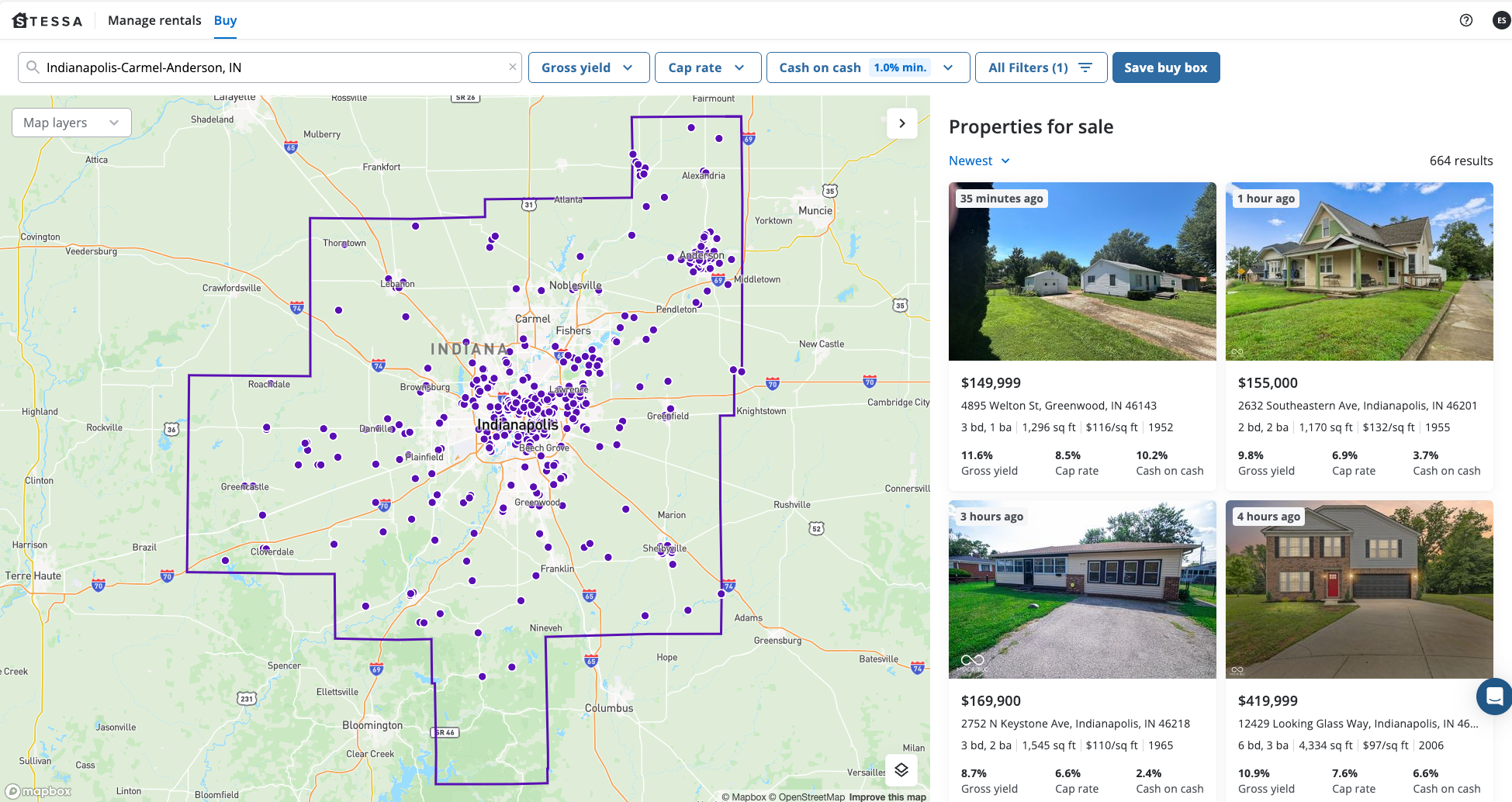
You can also buy and sell properties using Stessa’s investment property marketplace.
Unlike the generic listing sites built for browsing, Stessa is purpose-built for investors looking to underwrite and acquire their next investment. Evaluate properties with institutional-grade insights powered by Roofstock, and get notified in real-time when something meets your buy box.
How This Calculator Works
1) Income & Vacancy
-
Annual Gross Rent = Monthly Rent × 12
-
Vacancy Deduction = (Gross Rent ÷ 365) × Vacancy Days
-
Net Rent = Gross Rent − Vacancy Deduction
2) Operating Expenses (Annual)
-
Property Tax Cost = Purchase Price × Property Tax Rate
-
Repairs & Maintenance Cost = Gross Rent × Repairs & Maintenance %
-
Management & Leasing Fees = (Gross Rent × Property Mgmt %) + (Monthly Rent × Leasing Months)
-
Total Expenses = Sum of all annual expense items above
3) Operating Metrics
-
NOI (Net Operating Income) = Net Rent − Total Expenses
-
Cap Rate = (NOI ÷ (Purchase Price + Make Ready Cost)) × 100
-
We include Make Ready Cost in the denominator to reflect your true basis in the property.
4) Financing & Returns
-
We compute a standard amortizing loan from Down Payment, Interest Rate, and Amortization (loan amount is based on Purchase Price).
-
Mortgage Payment (Principal + Interest) = 12 × scheduled monthly payment
-
Net Cash Flow (Annual) = NOI − Annual Debt Service
-
Monthly Cash Flow = Net Cash Flow ÷ 12
-
Cash-on-Cash Return = (Net Cash Flow ÷ (Down Payment + Make Ready Cost)) × 100
-
We treat Make Ready Cost as cash invested by default.
5) Targets Achieved? ✅ / ⚠️
Enter your targets and the calculator instantly flags whether the deal, as modeled, hits them:
-
Target Monthly Cash Flow → compares to Monthly Cash Flow
-
Target Cap Rate → compares to Cap Rate
-
Target Cash-on-Cash Return → compares to Cash-on-Cash Return
This is the key differentiator: most calculators stop at outputs, while ours evaluates your investment goals in real time.
Understanding Each Input
Purchase
-
Purchase Price ($)
The contract price for the property (exclude make-ready). We use this for loan sizing and property taxes. -
Down Payment (%)
The portion of the purchase price you pay upfront. Higher down payments reduce debt service (better cash flow) but can lower cash-on-cash returns. -
Interest Rate (%), Amortization (years)
These determine your monthly mortgage payment and total annual debt service. -
Make Ready Cost ($)
One-time upfront spend to get the unit rent-ready (paint, minor repairs, cleaning, locks, etc.). We add this to your investment basis for Cap Rate and to cash invested for Cash-on-Cash.
Income
-
Monthly Rent ($)
The expected monthly rent at stabilization. -
Annual Vacancy (days)
Days per year you expect the unit to sit vacant. Using days keeps the estimate realistic and easy to reason about.
Operating Expenses (Annual)
-
Property Tax Rate (%)
Annual property taxes as a percent of the purchase price. -
Insurance ($)
Annual premium for landlord/DP3 or equivalent coverage. -
Repairs & Maintenance (%)
Percentage of gross rent you set aside for ongoing upkeep. -
Leasing Fee (months)
Cost to place a tenant, expressed in months of rent (e.g., 0.5 = half a month). -
Property Management Fee (%)
Percentage of gross rent paid to a manager. Include it even if you self-manage to avoid overestimating returns.
Frequently Asked Questions
What makes this calculator different?
You can set three ROI targets (Monthly Cash Flow, Cap Rate, and Cash-on-Cash) and the calculator shows a green check (yes) or red alert (no) for each. That turns raw numbers into a quick go/no-go assessment based on your goals.
Why include Make Ready Cost in Cap Rate and Cash-on-Cash?
Make-ready is real money you invest to get the unit rentable. Including it in the Cap Rate denominator (Purchase + Make Ready) and Cash-on-Cash denominator (Down Payment + Make Ready) prevents inflated returns.
Is Make Ready Cost assumed to be financed?
By default, no. We treat make-ready as cash. If you plan to finance it (e.g., through a renovation/rehab loan), adjust your assumptions accordingly.
How should I choose my targets?
-
Monthly Cash Flow: Pick a number that compensates you for risk and effort after debt service.
-
Cap Rate: Align with your market and risk tolerance; remember our cap uses total basis (purchase + make-ready).
-
Cash-on-Cash: Many buy-and-hold investors aim for 5–12% depending on market, leverage, and strategy.
How are vacancy and leasing fees modeled?
Vacancy is entered as days per year. Leasing fees are modeled as months of rent and applied annually, which approximates average turnover over time.
Do you calculate taxes or DSCR?
No. To keep the focus on underwriting and goal-fit, we removed depreciation, taxable income, income taxes, after-tax returns, and DSCR from this version. If you need tax-aware modeling, use our income-tax calculator or talk with your accountant.
Tips for Better Underwriting
-
Stress-test rent (±5–10%), vacancy (+10–20 days), and interest rate (±1%) to see if you still hit your targets.
-
Include management even if you self-manage today.
-
Be honest about make-ready—underestimating here is a common reason deals miss cash-on-cash goals.