

Hugh Cameron of Newsweek reports this week that Moody’s Chief Economist Mark Zandi has issued a “red flare” warning for the housing market, citing it as a potential threat to the broader economy. Zandi points to persistently high mortgage rates near 7% as the driving force behind a sharp decline in homebuilding, sales, and price stability. In May alone, new single-family home sales fell 13.7% month-over-month and 6.3% year-over-year, with Zandi describing overall home sales as “uber depressed.” He cautions that unless rates drop soon, the housing sector could become a significant headwind to economic growth and potentially tip the U.S. into a recession.
Diana Olick of CNBC reports that nearly one-third of the 100 largest housing markets are now experiencing annual home price declines of at least 1%. National home price growth slowed to 1.3% in June (the weakest in two years) while inventory surged 29% year-over-year, softening the market. Single-family home prices ticked up 1.6%, but condo prices fell 1.4%. Despite rising supply, high mortgage rates in the high-6% range are dampening demand, causing longer time on market and seller hesitation.
In a second CNBC article, Olick reports that homebuilders are slashing prices at the fastest pace in three years as buyer demand weakens amid economic uncertainty and persistently high mortgage rates. Builder confidence rose slightly in July to 33, but remains in negative territory for the 15th consecutive month.
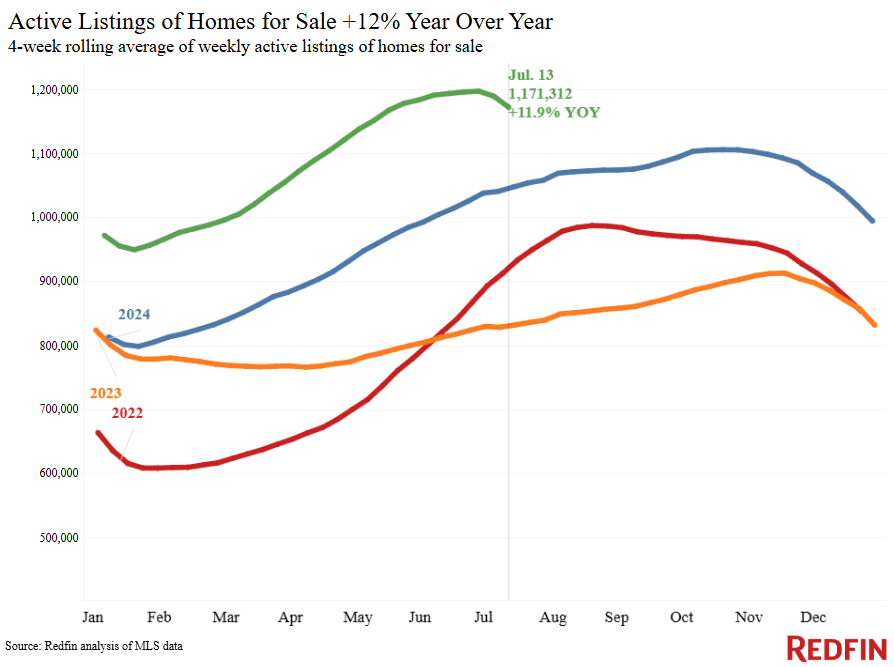
Dana Anderson of Redfin reports that the housing market continues to shift in favor of buyers, as sellers increasingly lower prices to meet diminished demand. According to its data, the median asking price rose just 2.9% year-over-year to $407,000 (its smallest gain in 2025) while the sale price rose only 1.7%, outpaced by average wage growth of 4%, making homes relatively more affordable. New listings dropped nearly 1%, pending sales fell 2%, and total inventory is up 12%, highlighting a growing supply-demand imbalance.
Source: Redfin (July 2025)
Orphe Divounguy of Zillow highlights that single-family housing starts fell 4.6% in June and are now 10% below last year’s levels, signaling growing caution among homebuilders amid rising unsold inventory. While overall housing starts increased 4.6% from May due to a rebound in multifamily construction, the persistent accumulation of unsold new homes and a sluggish buying season have shaken builder confidence. Resale inventory also hit its highest level since 2019, giving buyers unprecedented leverage. Price growth has slowed, especially in the Sun Belt, and builders are increasingly offering incentives.
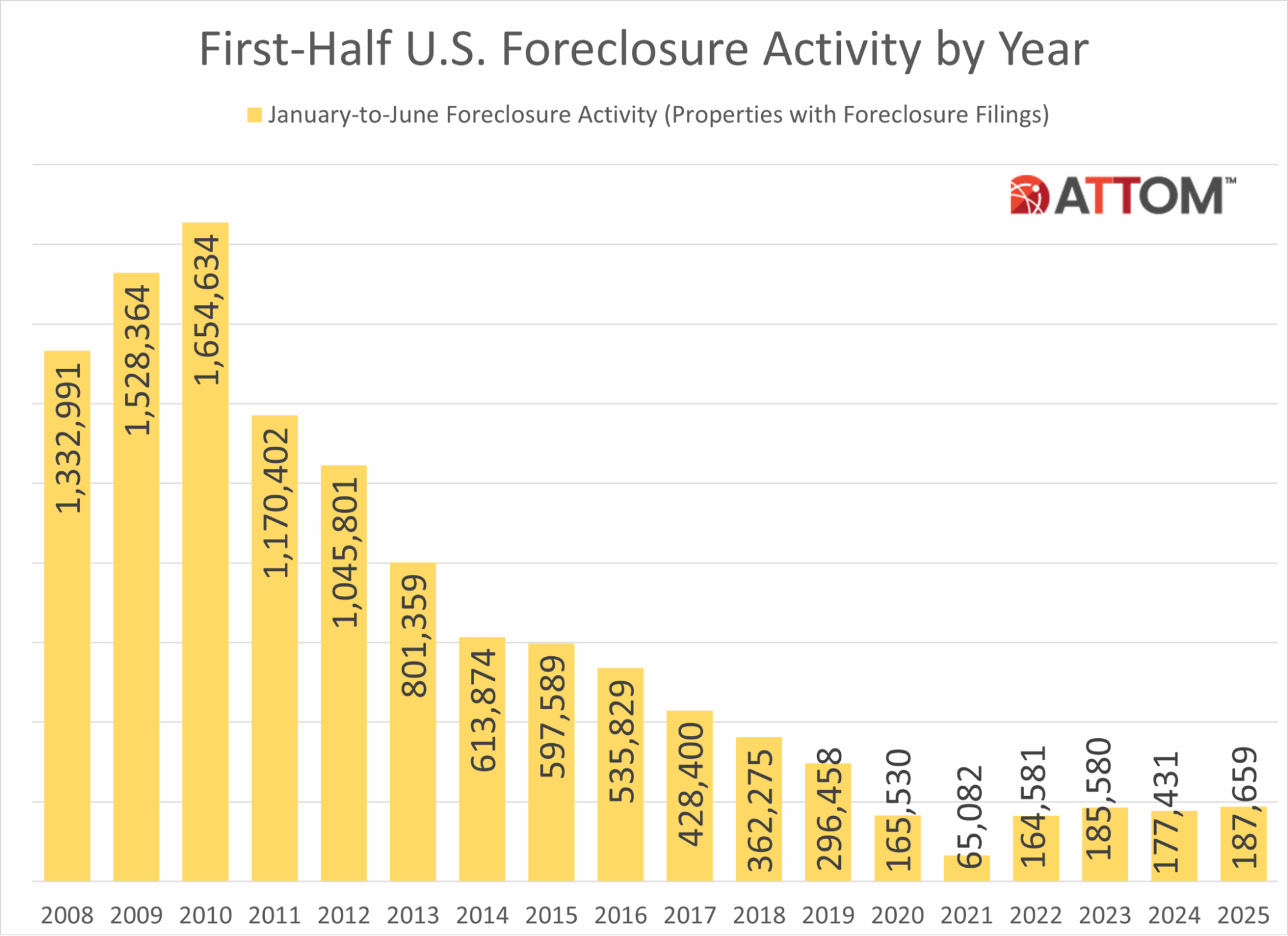
ATTOM Data Solutions reports that foreclosure activity continued to rise in the first half of 2025, with 187,659 properties receiving foreclosure filings, a 5.8% increase from the same period in 2024 and a 1.1% decrease from 2023. Foreclosure starts rose 7%, while the average time to complete a foreclosure dropped for the third straight quarter. Though still below pre-pandemic levels, the upward trend signals ongoing financial strain for some homeowners. The states with the sharpest increases include Alaska (+55%), Rhode Island (+51%), and Wyoming (+46%).
Source: ATTOM (July 2025)
Mortgages
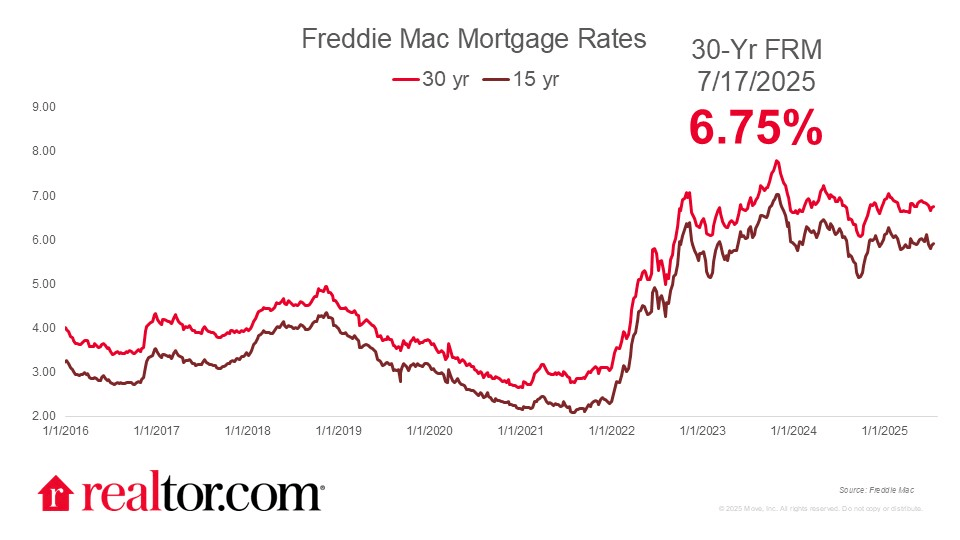
Jiayi Xu of Realtor.com reports that mortgage rates rose to 6.75% this week, tracking a climb in 10-year Treasury yields after June inflation hit a four-month high. With the Fed likely to maintain its cautious stance, rates are expected to stay elevated, deepening affordability woes. In June 2025, the income needed to buy a typical home jumped to $92,160, up 93% from 2019, due to rising rates and a 37.8% surge in home prices. This growing financial strain is prompting many buyers to look beyond expensive metropolitan areas, such as San Jose and Washington, D.C.
Source: Realtor.com (July 2025)
Logan Mohtashami of HousingWire reports that mortgage spreads have nearly returned to normal, now just 0.49% above historical averages; a key shift that could allow mortgage rates to drop to around 6% even if the 10-year Treasury yield stays above 4%. This is significant because housing demand tends to improve when rates move closer to 6%, a threshold that has not yet been sustained in 2025. Despite market noise, including chatter around Fed Chair Jerome Powell and inflation data, the narrowing spread offers a glimmer of hope for improved affordability without necessitating drastic declines in bond yields.
The Mortgage Bankers Association (MBA) reports that mortgage applications for new home purchases rose 8.5% year-over-year in June 2025, despite a 4% monthly decline tied to seasonal trends. Elevated mortgage rates and economic uncertainty continue to challenge buyers, but increased inventory, builder incentives, and lower prices are drawing some back into the market.
Joel Kan, MBA’s Vice President and Deputy Chief Economist, comments:
“Applications to purchase new homes fell in June, consistent with typical seasonal patterns, but remained ahead of last year’s pace…A cloudier economic outlook and elevated mortgage rates continues to weigh on potential buyers, while growing inventory, builder incentives, and lower prices have brought some buyers back to the market. As a result, we continue to see home sales ebb and flow. MBA’s estimate of new home sales increased to a sales pace of 667,000 units, up on a monthly and annual basis.”
Dana Anderson of Redfin reports that nearly one-quarter (23.8%) of Gen Z and millennial homebuyers relied on family money, either in the form of a cash gift or an inheritance, for their down payment. While over half (56.5%) of young buyers saved from their paychecks, family assistance remains the second most common source of funding. Additionally, 18% of respondents reported living with family or friends to cut costs while saving, highlighting how intergenerational support is playing a growing role in helping younger Americans enter the housing market.
MLS update
Brooklee Han of HousingWire reports that Zillow has officially responded to Compass’s motion for a preliminary injunction, firmly denying allegations of conspiracy and monopoly power. In its filing, Zillow argues that Compass has not demonstrated irreparable harm and rejects claims of antitrust violations. The response includes declarations from top Zillow executives, including CEO Jeremy Wacksman and Chief Industry Development Officer Errol Samuelson, signaling the company’s intent to defend its business practices vigorously amid ongoing legal scrutiny.
Jonathan Delozier, also of HousingWire, reports that Zillow’s new listing policy is facing criticism from Homes.com CEO Andy Florance, who argues the move is more about market control than fairness. The policy requires publicly marketed listings to appear on an MLS and Zillow within 24 hours, or risk being removed, prompting concerns about competitive neutrality in an already heated real estate tech landscape.
Stephanie Reid-Simons of Real Estate News reports that Zillow has pushed back against Compass’s antitrust lawsuit, arguing in a court filing that it is under no legal obligation to operate by Compass’s preferred business model. Zillow defends its Listings Access Standards, which require listings to be shared with Zillow or an MLS within one business day of public marketing, as pro-consumer and non-collusive, despite Compass citing discussions with Redfin and eXp as evidence of conspiracy. Zillow maintains the rules promote transparency, while Compass counters that the policy restricts homeowner choice and mirrors monopolistic behavior.
Deborah Kearns of Quartz reports that a high-stakes legal clash between Zillow and Compass could reshape how homes are bought and sold in the U.S. At the heart of the battle is Zillow’s new policy banning listings from its platform if they’re publicly marketed but not shared via an MLS within one business day. This is a direct hit to Compass’s strategy of private, agent-first listings. Compass responded with a federal antitrust lawsuit, arguing the policy harms consumer choice, while Zillow claims it ensures transparency and aligns with the National Association of Realtors’ Clear Cooperation Policy.
Finally, Jonathan Delozier of HousingWire reports that the real estate tech space saw two significant developments this week: Realtor.com’s parent company, Move Inc., acquired Zenlist, a startup focused on agent-client collaboration, which enhances its mobile-first approach and expands tools for over 35,000 agents. Meanwhile, Zillow rolled out five new features aimed at simplifying the buying and renting process, including drone-powered 3D tours, offer competitiveness insights, transparent rental breakdowns, intelligent tour scheduling, and updated affordability estimates, further intensifying the platform battle in real estate tech.