Jake Krimmel of Realtor.com reports that Freddie Mac’s 30-year fixed mortgage rate edged down 3 basis points to 6.18% this week (from 6.21% last week), sitting near 2025’s late-October lows as bond markets moved within a tight range amid mixed macro signals; including a weak November jobs report, a soft inflation read last week, and a stronger-than-expected Q3 GDP print. Further, a thin holiday trading and limited new data (including shutdown-related gaps) kept rates drifting rather than swinging. He notes that finishing the year near the lowest rates of 2025 is a tailwind for 2026 homebuyers, especially since most declines arrived in late summer/early fall after demand cooled.

Source: Realtor.com (December 2025)
“While this week’s move is small, ending the year with mortgage rates near their lowest level of 2025 is a welcome development for homebuyers heading into 2026. Most of the rate declines this year came in late summer and early fall, when seasonal demand was already cooling, meaning most prospective buyers haven’t fully felt the benefit yet. Right now, inventory remains higher than last year in most markets, and buyers are heading into 2026 with a meaningfully better rate environment than they faced during the 2025 spring season, when mortgage rates were over 6.80%.”
Mike Fratantoni of the Mortgage Bankers Association (MBA) reports that total mortgage applications fell 5.0% week over week (Market Composite Index -5.0% seasonally adjusted; -6% unadjusted), with refis down 6% (+110% vs. a year ago) and purchase applications down 4% SA (-6% unadjusted) but still +16% year over year. The refi share ticked up to 59.1% (from 59.0%) and ARM share rose to 8.1%; FHA share increased to 20.8% (from 19.5%) while VA share dipped to 15.3% (from 16.6%).
“Overall mortgage application volume fell last week, despite the slight decline in mortgage rates…MBA expects the trends of a softening job market, sticky inflation, elevated home inventories, and steady mortgage rates will persist into the new year.”
Fratantoni notes that rates were mixed: 30-year conforming eased to 6.31% (from 6.38%), 30-year jumbo rose to 6.52% (from 6.44%), 30-year FHA inched up to 6.14% (from 6.12%), and 15-year slipped to 5.70% (from 5.72%), as MBA expects soft jobs, sticky inflation, elevated inventory, and steady rates to persist into 2026 while forecasting modest home-sales growth.
Joy Dumandan of Realtor.com notes that even as Freddie Mac’s 30-year fixed rate dipped to 6.21% (week ending Dec. 18), mortgage applications still fell 5% for the week ending Dec. 19 (a second straight weekly decline), highlighting that demand remains fragile despite slightly cheaper financing. Dumandan emphasizes the shift in composition of activity: refis made up 59.1% of applications (up from 59.0%), while ARMs rose to 8.1%. The government lending mix also shifted (FHA share increased to 20.8%, VA share decreased to 15.3%, and USDA share remained steady at 0.4%). On pricing, contract rates diverged by segment—conforming 30-year fell to 6.31% while jumbo rose to 6.52%, underscoring a market where small headline rate drops aren’t yet translating into broader borrower momentum.
Matthew Kazin and Eric Revell of Fox Business report that downward rate movement comes amid mixed economic signals: Q3 GDP grew at an annualized 4.3% (beating the 3.3% forecast), November CPI rose 2.7% year-over-year (cooler than the expected 3.1%), and employers added just 64,000 jobs as unemployment climbed to 4.6%—the highest since September 2021. With inventory higher than last year in most markets, buyers could see increased purchasing power in 2026 if rates hold steady or decline further.
Housing supply
Lily Katz of Redfin reports that the housing market had an estimated 37.2% more sellers than buyers in November (529,770 more in numerical terms); the largest gap in Redfin records dating back to 2013, aside from summer 2025, up from 35.6% a month earlier and just 17% a year ago. The gap has hovered above 35% since April, firmly establishing a buyer’s market (defined as 10%+ more sellers than buyers) that has persisted since May 2024. Regionally, Austin, TX ranks as the strongest buyer’s market while Nassau County, NY is the strongest seller’s market, with San Francisco notably flipping from buyer’s to seller’s market territory.

Source: Redfin (December 2025)
Redfin Senior Economist Asad Khan suggests modest affordability improvements could bring buyers off the sidelines in 2026, but expects the market to remain buyer-favorable for the foreseeable future.
Diana Olick of CNBC reports that existing home sales rose just 0.5% in November from October (4.13 million annualized units), while inventory fell 5.9% monthly to 1.43 million homes, representing a 4.2-month supply versus the 6-month balanced benchmark. The median sale price hit a record November high of $409,200 (up 1.2% year-over-year), with homes sitting on market for 36 days compared to 32 days last year. Iinventory growth is beginning to stall as homeowners with record-high housing wealth show no urgency to list during winter months.
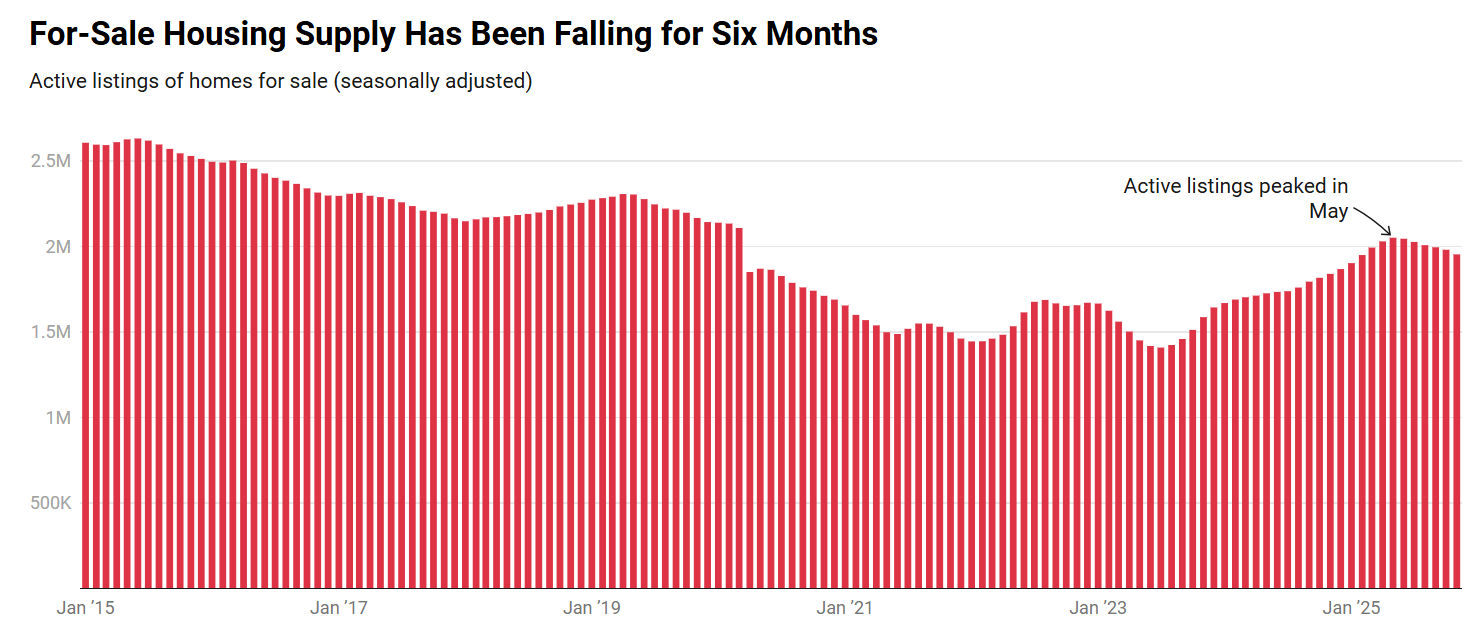
Lily Katz of Redfin reports that active home listings fell 1.4% month-over-month in November (the largest drop since June 2023) while new listings declined 2.2% to their lowest level since April 2024. Homes that sold went for 1.6% below final list price (the steepest November discount in six years), and the typical sale took 53 days, the slowest November pace in nearly a decade. Median home sale price rose just 0.7% year-over-year to $433,222, marking the weakest growth since June 2023, as sellers retreat amid sluggish buyer demand driven by elevated mortgage rates and economic uncertainty.
Source: Redfin (December 2025)
Finally, Logan Mohtashami of HousingWire comments on this reality, noting that housing inventory growth has been cut roughly in half over the course of 2025, dropping from over 30% year-over-year growth earlier in the year to just 13.54% currently, driven by shifting new listings patterns and sales dynamics alongside mortgage rate and spread fluctuations. The Housing Market Tracker will pause until January 10th, as Mohtashami cautions against overinterpreting housing data during the holiday weeks.
Rents
Orphe Divounguy of Zillow reports that the typical asking rent fell 0.3% in November to $1,925, with Sun Belt and Mountain West markets seeing the sharpest annual declines—Austin (-3%), San Antonio (-2.3%), and Denver (-1.8%); driven by the multifamily construction boom. Nearly two in five listings (39.3%) now include concessions, the highest November share since Zillow began tracking, reflecting elevated vacancy rates and increased renter bargaining power.
Further, annual rent growth has cooled well below pre-pandemic averages, with single-family rentals at 3% (vs. 4.3% pre-pandemic) and multifamily at just 1.5% (vs. 3.6%), and Zillow forecasts further softening in 2026: single-family up 1.6%, multifamily down 1%.
“Rent growth is expected to stay muted through winter as leasing activity slows and incentives remain common. Zillow forecasts rent growth to ease further in 2026. Single-family rents are expected to rise by just 1.6% compared to a 1% decline for multifamily rents.”
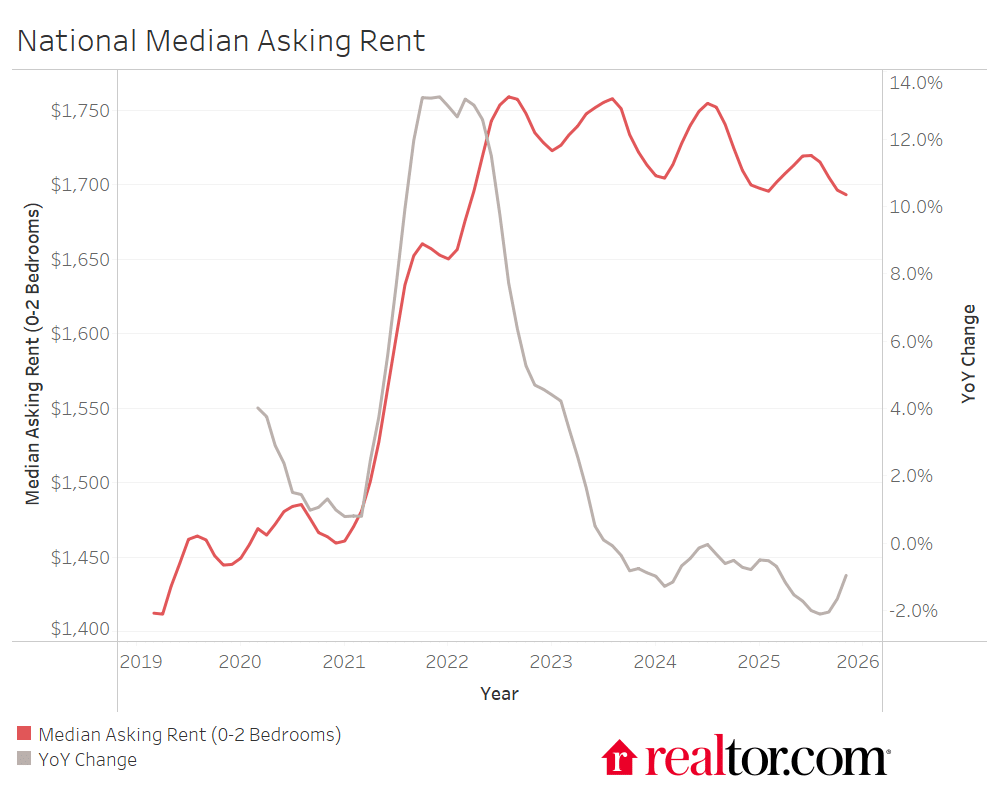
Joel Berner and Danielle Hale or Realtor.com report that the median asking rent across the 50 largest U.S. metros fell to $1,693 in November, down 1% year-over-year and marking the 28th consecutive month of annual declines, though rents remain 17.2% higher than November 2019’s $1,445. Studio units are showing signs of stabilization at just -0.4% year-over-year compared to -1% for 1-bedroom and -1.1% for 2-bedroom units, suggesting slightly improving rental demand.
Source: Realtor.com (December 2025)
Affordability remains strained at the lower income levels: only 5 of the 50 largest metros allow two minimum-wage workers at 40 hours per week to afford the median rental, though minimum wage increases in Michigan and Florida will add two more metros to that list in 2026.
“Though rents have been falling over the past several years, they remain significantly elevated compared to where they were before the COVID-19 pandemic and represent a major financial hurdle to households across the country. This is especially true for those at the lowest end of the income spectrum. The federal minimum wage ($7.25/hour), which is not superseded by state or local minimum wages for much of the country, has not changed since 2009, making it increasingly difficult for minimum-wage earners to afford their rent.”