

Megan Hunt reports that ATTOM’s Q3 2025 U.S. Housing Risk Report identified a heavy geographic concentration of housing market vulnerability, with 16 of the top 50 highest-risk counties in California, followed by New Jersey (9), Florida (4), and Arizona and Texas (3 each), based on affordability, underwater mortgages, foreclosure rates, and unemployment; the three highest-risk markets nationally were Butte County, CA (48.6% of income needed to buy, 4% underwater, 1 in 735 homes in foreclosure, 6.8% unemployment), Humboldt County, CA (50.2% of income, 3.1% underwater, 1 in 803 in foreclosure, 6.1% unemployment), and Charlotte County, FL (39.1% of income, 7% underwater, 1 in 499 in foreclosure, 5.1% unemployment), while the lowest-risk counties posted <4% unemployment and foreclosure rates no worse than 1 in 2,624 homes.
The ATTOM Team also reported that the report shows mounting pressure across housing markets, as the national median home price hit a record $375,000. Ownership costs consume at least one-third of wages in 63.1% of counties and at least half of salaries in 19.8% (115 of 580) of counties. The least risky markets were concentrated in Wisconsin, Tennessee, Montana, New Hampshire, and Virginia, all of which showed lower unemployment and foreclosure rates, with no worse than 1 in 2,624 homes.
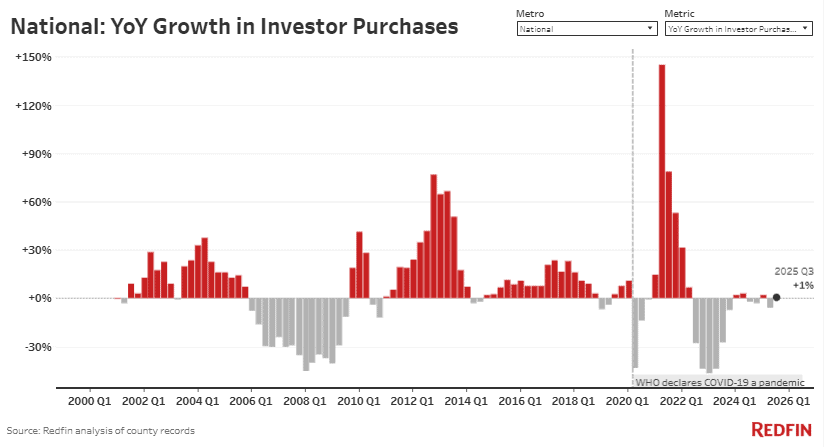
Dana Anderson of Redfin reports that U.S. investors remain cautious, with home purchases rising just 1% year-over-year to roughly 52,000 homes in Q3 2025. Investors accounted for 17% of all home sales (up slightly from 16%), signaling a market stuck in neutral as 8% of investor-owned homes sold at a loss (the highest level in over two years) while typical investor capital gains fell to $182,688, down 1% YoY.
Source: Redfin (December 2026)
Investor activity is being constrained by high prices, elevated mortgage rates, cooling rent growth, rising vacancies, and economic uncertainty, with condo purchases down 1% and sitting near a decade-low, investors pulling back most sharply in Las Vegas and Florida, and analysts at Redfin noting that profits for flippers and landlords are increasingly difficult to achieve in the current environment.
Sheharyar Bokhari, a senior economist at Redfin, comments: “Investor activity is stuck in neutral because profits are harder to come by, more homes are selling at a loss, and the rental market has softened…Investors aren’t completely retreating, but they’re not driving the housing market forward.”
Anderson also reports in a second article that U.S. housing market risk is rising as inventory growth slows to just 5.1% year over year (the smallest gain in nearly two years), while new listings rose only 0.9%, pending sales fell 2.6%, and delistings accelerated as sellers resist price cuts; despite mortgage payments dipping 1.2% YoY, sale prices are up 2.2% and rates remain above 6%, pushing the typical time on market to 50 days, about a week longer than last year, signaling mounting demand weakness and growing pricing friction.
Anushna Prakash or Zillow reports that home sellers offered record cumulative price cuts of $25,000 in October 2025, matching the largest discounts ever tracked by Zillow, as affordability improved to a three-year best and slower sales forced sellers to recalibrate. While the typical individual price cut remains near $10,000, multiple reductions are increasingly common as listings linger, with the most significant absolute discounts in San Jose ($70,900), Los Angeles ($61,000), San Francisco ($59,001), New York ($50,000), and San Diego ($50,000), and the largest relative discounts in Pittsburgh and New Orleans (both ~9% of home value) and Austin (8.4%).
Housing predictions
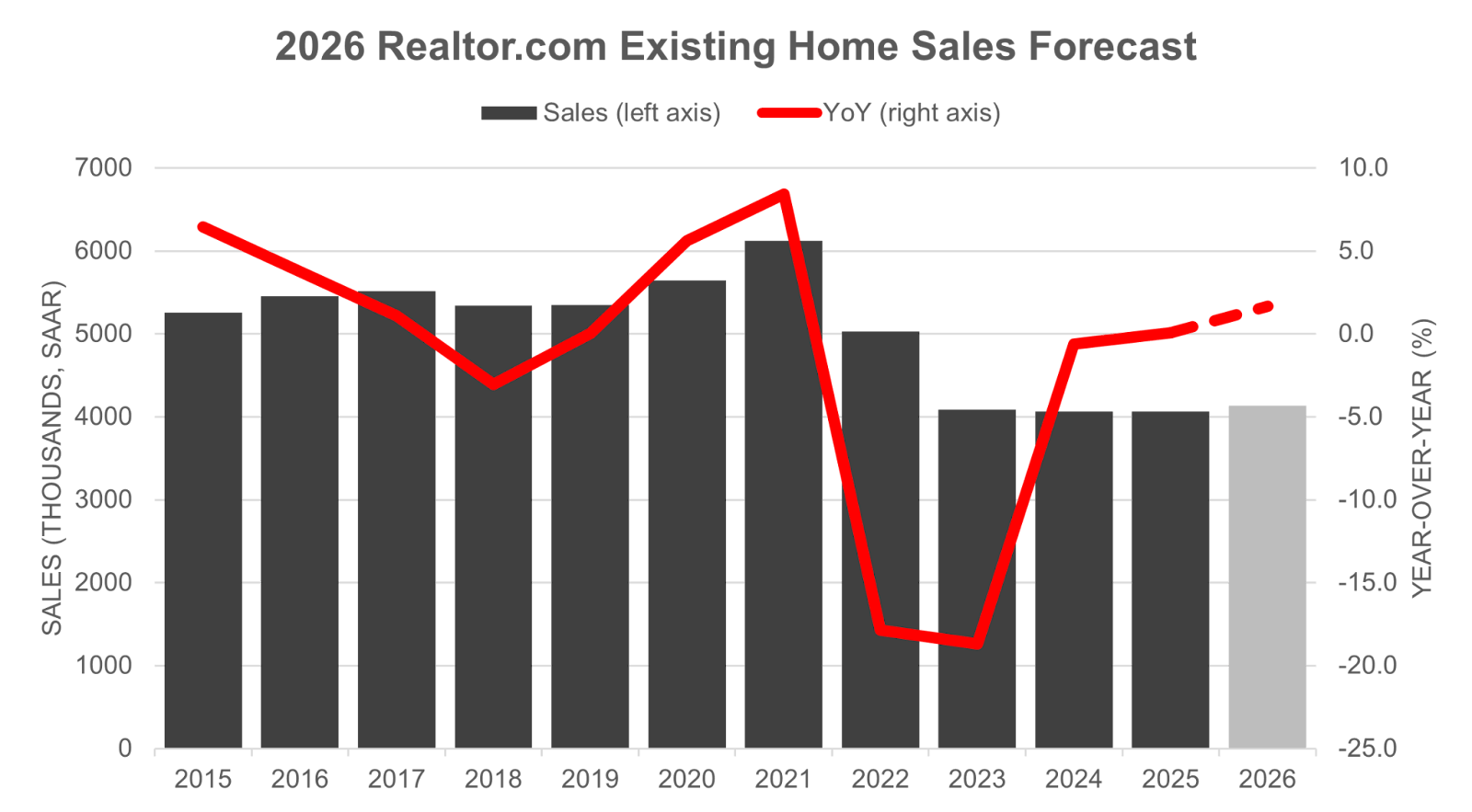
Several outlets offered 2026 housing market predictions as we look to close off the year, starting with Realtor.com’s 2026 Housing Forecast. The analysis indicates a slow but stabilizing housing market in 2026, with mortgage rates averaging 6.3% and home prices rising modestly by 2.2%. Existing-home sales will inch up 1.7% to 4.13 million from near 30-year lows. In comparison, for-sale inventory grows 8.9% year over year, shifting the market into a more balanced, mildly buyer-friendly environment as affordability improves and rent growth turns negative. Here are some additional highlights from the forecast:
- Inventory: +8.9% YoY growth, third straight year of recovery, but still ~12% below pre-2020 levels.
- Monthly buyer payments: -1.3% YoY, first annual decline since 2020.
- Affordability threshold: The typical mortgage falls to 29.3% of income, the first time it has been below 30% since 2022.
- Homeownership rate: Expected to dip slightly to 64.8%.
- Rent growth: -1.0% nationally, with the biggest relief in the South and West.
- Vacancy rates: Expected to approach or exceed the 7.2% long-term average by late 2026.
- Buyer leverage: Negotiating power gradually tilts toward buyers as inventory outpaces sales growth.
Source: Realtor.com (December 2025)
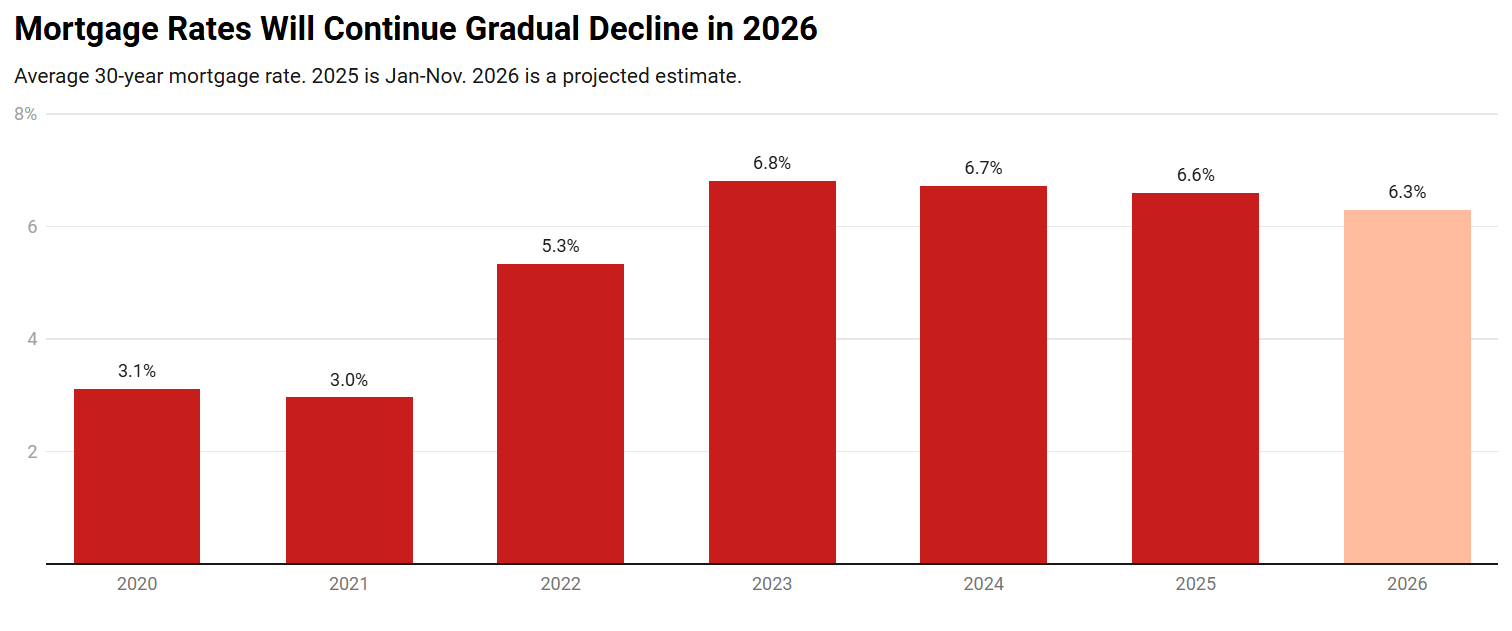
Chen Zhao and Daryl Fairweather outline Redfin’s analysis, forecasting that 2026 will mark the true beginning of a slow, multi-year “Great Housing Reset.” This is defined not by a crash or a boom, but by a long stretch of gradual normalization as affordability very slowly improves, buyer psychology shifts from desperation to patience, and structural forces (from demographics to policy and climate) reshape where and how Americans live. Here are some additional insights:
- Mortgage rates drift in the low-6% range (~6.3%), with occasional dips below 6% but no sustained drop.
- Home prices rise just ~1% YoY, while wages grow faster than prices for the first time since the Great Financial Crisis era.
- Existing-home sales increase ~3% to ~4.2 million, driven by slightly better affordability and a stronger spring season.
- Rents reverse course and rise 2%–3% as apartment demand outpaces new supply.
- Gen Z and millennial homeownership remains stalled, with more roommates, multigenerational living, and delayed family formation.
- Refinancing volume jumps 30%+ to ~$670B, and homeowners increasingly tap equity for renovations (typical untapped equity ~$181K).
- Housing market winners: NYC suburbs, Great Lakes metros (Cleveland, St. Louis, Minneapolis, Madison), and Syracuse.
- Cooling markets: Nashville, Austin, San Antonio, and coastal Florida, due to insurance costs, disasters, and reversals in remote work.
- Climate migration is becoming increasingly hyper-local, with buyers shifting within metropolitan areas (not across states) to reduce risk.
- MLS consolidation accelerates as NAR steps back from centralized rule-making, giving more power to regional MLS networks.
Source: Redfin (December 2025)
Finally, Mischa Fisher of Zillow reports on its predictions that 2026 will mark a measured thaw in the housing market, with activity picking up modestly as affordability improves, equity stabilizes for more owners, and rents ease for many households. According to Zillow, this will signal a shift toward a healthier, more balanced market after several years of volatility. Here are some additional insights:
- Home values: +1.2% growth, with major markets seeing price declines falling from 24 to 12.
- Existing-home sales: 4.26 million, a +4.3% increase year over year.
- Mortgage rates: Expected to stay above 6% throughout 2026.
- Rent growth: Multifamily rents up just +0.3%; single-family rents +2.3%.
- Builders pull back: Single-family starts fall to the lowest level since 2019, with incentives driving sales.
- Underwater risk eases: Fewer homeowners are expected to owe more than their homes are worth.
- Lifestyle renting grows: Nearly 60% of renters plan to keep renting next year.
- Family-driven rentals are on the rise: 37% of renters now have a child, boosting demand for family-friendly amenities.
- NYC bucks the trend: Local rent growth expected to re-accelerate.
- Energy-efficient homes surge: EV charging, batteries, and smart storage become top priorities for mainstream buyers.