
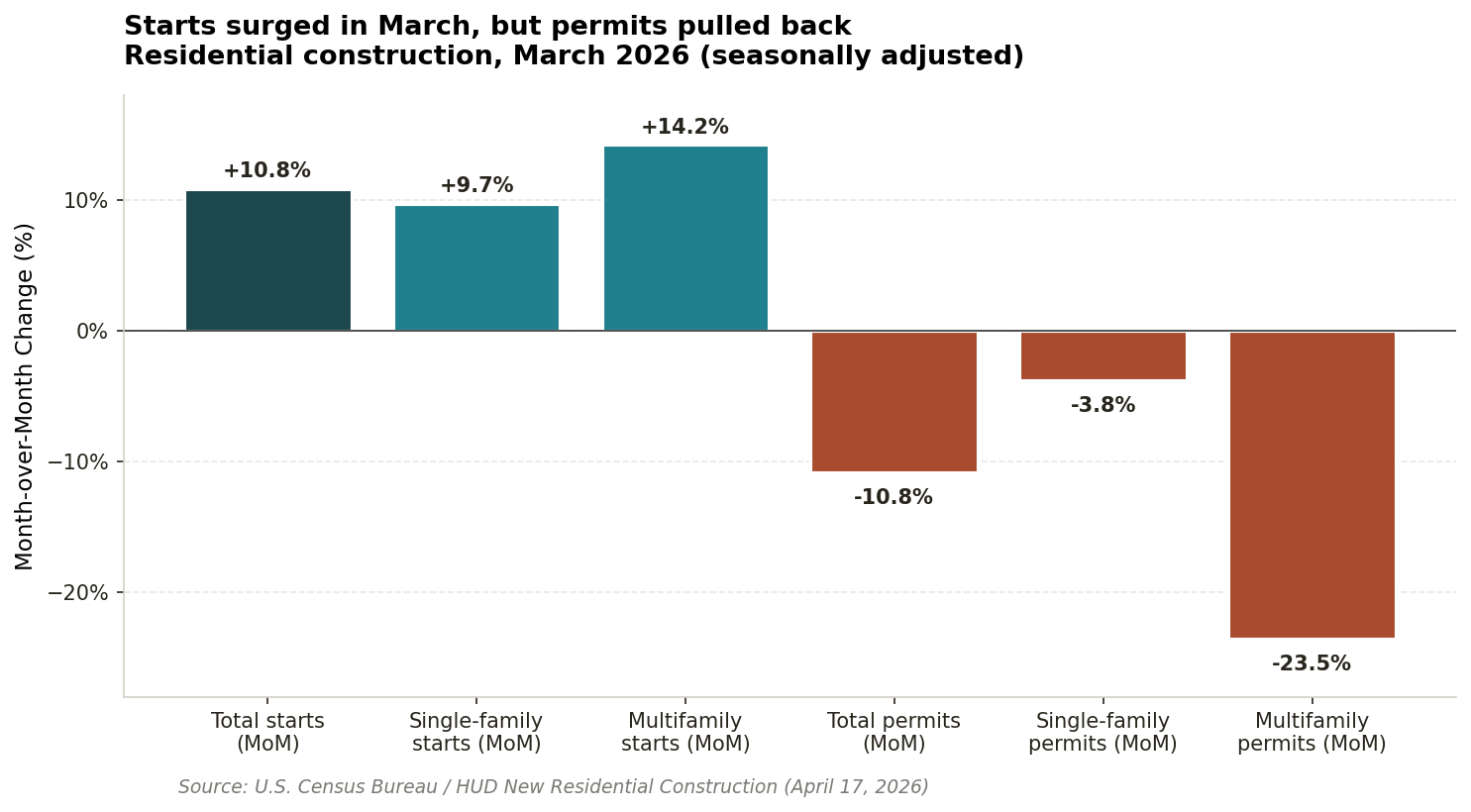
The U.S. Census Bureau reported that March housing starts surged 10.8% from February to a seasonally adjusted annual rate of 1,502,000, also 10.8% above the March 2025 pace. Single-family starts climbed 9.7% month over month to 1,032,000 SAAR. Building permits, however, told a different story: total permits fell 10.8% on the month to 1,372,000 SAAR and ran 7.4% below year-ago levels, with the 5-unit-or-more category cratering 23.5%.
Source: U.S. Census Bureau (May 5, 2026)
That said, Orphe Divounguy of Zillow Research noted that while builders are finishing previously authorized work, the permit pullback trailed 2025 levels in March across both single-family and multifamily. Rising competition from resale inventory and higher construction costs could weigh on future projects, and Zillow’s data shows the median price per square foot for newly built homes fell 1.8% year over year in February. Government-insured mortgages (FHA and VA) accounted for more than half of new-home mortgage applications for the third consecutive month.
“Housing starts increased nationwide and in every region in March. Single-family homebuilding increased in February and surpassed year-ago levels. While this means builders are starting and finishing previously authorized construction on current building sites, permitting activity for future projects trailed 2025 levels in March. Rising competition from resale inventory could continue to weigh on new home sales and thus, future building projects.”
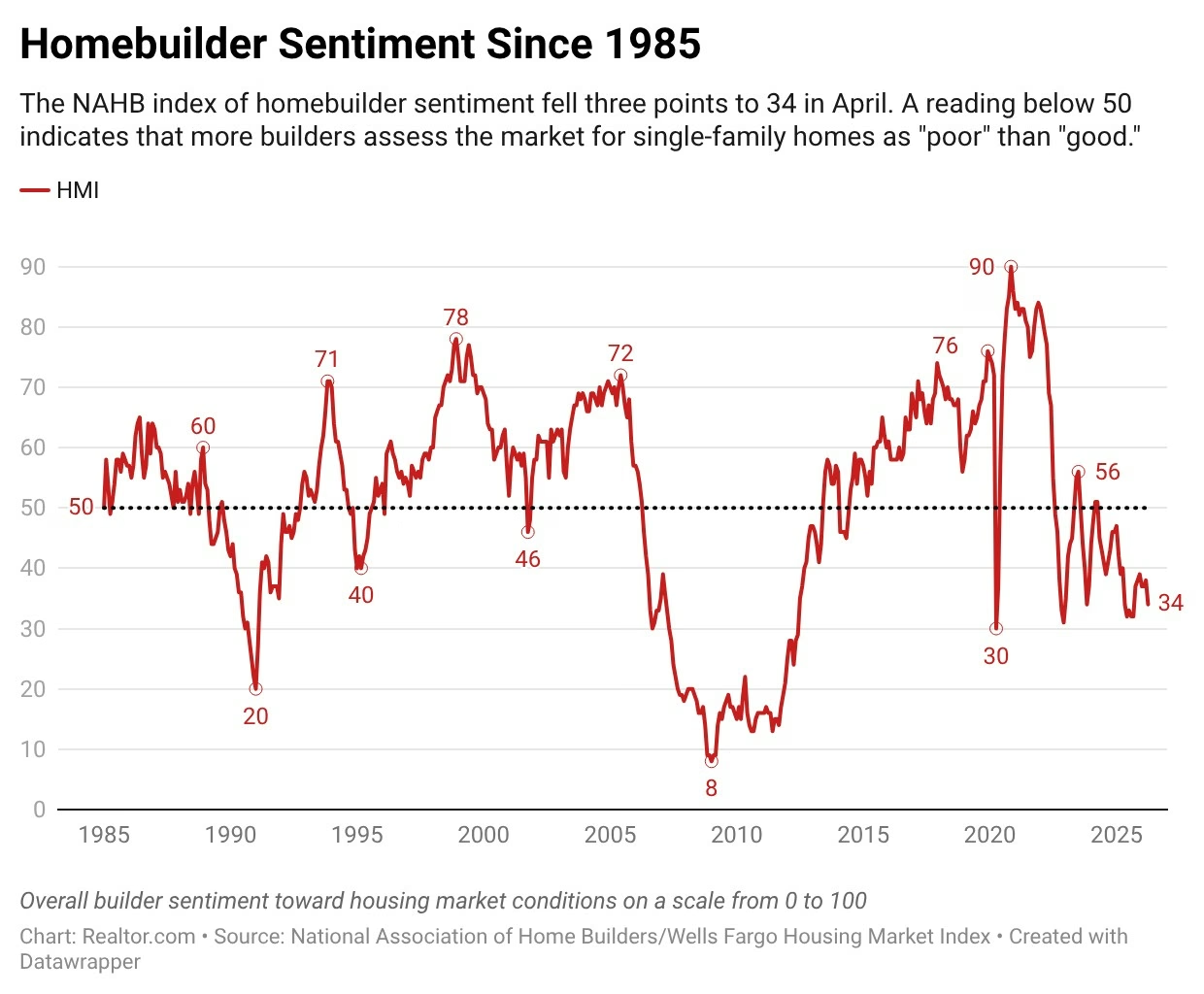
The National Association of Home Builders (NAHB) reported that builder confidence fell four points to 34 in April per the NAHB/Wells Fargo Housing Market Index, the lowest reading since September 2025 and well below the 50 threshold separating positive from negative sentiment. All three components declined: current sales conditions fell to 37, future sales expectations dropped seven points to 42, and prospective buyer traffic slipped to 22. Some 36% of builders cut prices in April and 60% used sales incentives, the 13th consecutive month at that level or higher.
“With oil prices higher in the U.S., 62% of builders reported suppliers have increased building material costs due to higher fuel prices, including gas and diesel. Energy costs make up approximately 4% of residential construction material input and service costs. With near-term economic risks elevated, 70% of builders reported challenges pricing homes given uncertainty about material costs.”
Finally, Snejana Farberov of Realtor.com contextualized the sentiment slide, noting that builder confidence plummeted to its lowest level in eight months just as the housing market entered the peak spring selling season. The decline was compounded by the ongoing Iran conflict that sent oil prices higher and reignited inflation fears. The West region took the biggest hit, with its three-month moving average falling three points to 29, while NAHB Chairman Bill Owens cited the war, energy costs, and declining consumer confidence as key headwinds slowing the market.
Source: Realtor.com (May 2025)
Spring market
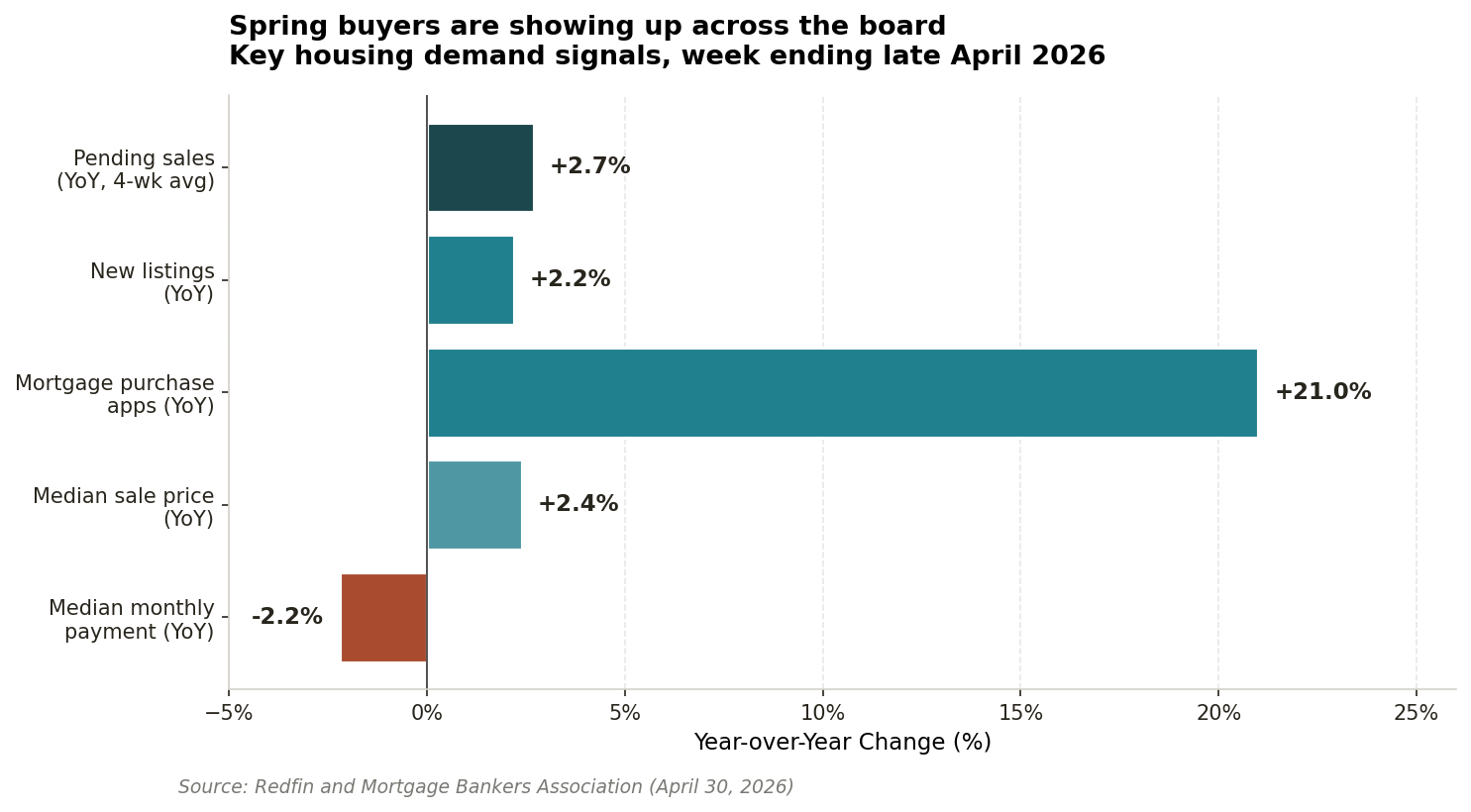
Redfin reported that U.S. pending home sales rose 2.7% year-over-year in the four weeks ending April 26, the biggest increase in six weeks, as mortgage purchase applications hit their highest level in three months. The median sale price reached $396,000 (up 2.4% year-over-year), but the median monthly payment fell 2.2% to $2,723 thanks to easing rates. New listings climbed 2.2% year-over-year, the second consecutive week of growth after five straight months of declines, while Google searches for ‘homes for sale’ hit a nine-month high.
Source: Redfin (May 2026)
“Even though more buyers are coming off the sidelines, some are still wondering if they should wait for mortgage rates to fall more before making a move. I tell them no – if you love a home and you can afford it, make an offer. It is a buyer’s market, but there is competition for desirable homes in popular neighborhoods. And while prices are lower than they have been over the past few years, they will rise quickly if bidding wars do pick up.”
That said, Matthew Graham of Mortgage News Daily noted that overall MBA application volume fell 1.6% on a seasonally adjusted basis for the week ending April 24, giving back some prior gains as the 30-year fixed conforming rate edged up to 6.37% from 6.35%. The pullback was entirely driven by refinance demand (the Refinance Index fell 4% week-over-week), while the seasonally adjusted Purchase Index rose 1% and stood 21% above year-ago levels. Conventional purchase activity led the way, picking up almost 2% on the week.
“More notably, purchase application activity was more than 20 percent above last year’s pace. After a brief pause, in part because of the elevated geopolitical uncertainties, potential homebuyers certainly appear to be moving forward this spring and taking advantage of the more favorable inventory conditions in most parts of the country.”
Further, Diana Olick of CNBC reported that home purchase applications bucked the broader application slowdown by rising 1% for the week and 21% year-over-year. Refinancing remains elevated versus a year ago (up 51%), when rates were roughly half a percentage point higher. Olick observes that buyers appear to be adapting to the geopolitical uncertainty surrounding the Iran conflict as it fades from headlines, supported by more available inventory than in recent years.
Liezel Once of MPA Magazine added that earlier in April, the 30-year rate had touched 6.57% (the highest since last August) before pulling back, triggering a 10.4% weekly drop in applications at that peak. The MPA piece also highlighted Fannie Mae’s Q1 2026 earnings: $3.7 billion in net income (its 33rd straight quarterly profit) with net worth at $112.7 billion. Fannie Mae provided $116 billion in liquidity in Q1, supporting roughly 154,000 home purchases and 121,000 refinances.
Finally, Freddie Mac reported that the 30-year fixed-rate mortgage averaged 6.30% for the week ending April 30, up from 6.23% the prior week but still well below the 6.76% recorded one year ago. The 15-year fixed rate climbed to 5.64% from 5.58%, also down from 5.92% a year ago. The Freddie Mac commentary noted that as rates modestly declined over recent weeks, purchase demand has accelerated, with purchase applications running over 20% above year-ago levels.
Office
Elizabeth Cryan, writing for The Real Deal, reports that AI companies are fueling an unexpected office market rebound, with CBRE, Newmark, and JLL all posting some of their strongest quarters since the pandemic. AI startups with fewer than a dozen employees are signing oversized leases in neighborhoods like NoMad and the Flatiron District, and Anthropic is reportedly close to taking all 466,000 square feet at 330 Hudson Street. The concern, however, is that McKinsey estimates AI could automate 25 to 33 percent of work hours by 2030, meaning the technology filling offices today may ultimately reduce how much space companies need tomorrow.
Diana Olick of CNBC reports that office demand hit its highest level since the pandemic began in Q1 2026, with the VTS Office Demand Index rising 18% from Q4 2025 and 13% year over year. San Francisco and New York are leading the recovery, driven by AI and diversified employment, while Los Angeles posted double-digit quarterly gains on the back of growth in the creative industry. National vacancy edged down to 22.2%, though the pain is concentrated: just 10% of office buildings account for more than 60% of total vacancy. Notably, the rebound is being driven not just by tech but also by finance and legal firms re-entering the market.
“The AI boom continues to be a dominant headline for office, and markets that lack a major tech presence, or are without a primary growth lever in another industry, are seeing declines in demand.”
Christopher Neely, also of The Real Deal, reports that San Francisco has become the only major U.S. gateway market to fully eclipse pre-pandemic office demand, with current tenant demand running 14% above its 2018-2019 average. AI is the clear driver: 67 AI companies searched for space in Q1 alone, seeking an average of 79,000 square feet each, contributing to a 124% year-over-year surge in total square footage demand. Tech accounted for 64% of that demand, anchored by Anthropic’s 460,000-square-foot lease and OpenAI’s 280,000-square-foot Mission Bay expansion. VTS CEO Nick Romito credits a cultural shift away from remote work as equally important, calling it “a 180-degree turn” that has had the single biggest impact on leasing activity.
Richard Berger of GlobeSt reports that institutional investors are returning to the office market in force, with investment sales volume climbing 41% year over year to $62.7 billion in 2025 and office lending originations surging 84%. San Francisco led capital markets activity with investment volume up 140% year over year, while New York posted 40% growth and hit 36.4 million square feet of leasing in 2025, its first time exceeding the 2010-2019 average. A historic supply contraction is reinforcing the recovery at the top end: annual office deliveries are expected to fall below 5 million square feet by 2027, down from more than 40 million pre-pandemic.
JLL’s Bruce Miller sees this as a tale of two markets, where trophy assets tighten further and rental rates spike, while lower-tier buildings continue to bleed tenants unless they happen to sit in prime micro-locations.