Corrie Driebusch of the Wall Street Journal reports that the Trump administration is preparing an IPO for mortgage giants Fannie Mae and Freddie Mac later this year, aiming to raise about $30 billion by selling 5%–15% of their stock at a combined valuation near $500 billion. This will be one of the largest offerings in history. The plan, which could involve listing the companies together or separately, follows months of groundwork and recent meetings between Trump, top bank CEOs, and senior administration officials.
Flávia Furlan Nunes of HousingWire reports that analysts are casting doubt on the Trump administration’s plan to IPO Fannie and Freddie by the end of 2025 at a combined $500 billion valuation, more than twice some market estimates, citing tight timelines, unresolved capital requirements, and uncertainty over how much control the federal government would retain post-offering.
Ben Berkowitz of Axios reports that President Trump, days after confirming plans to sell the government’s stakes in mortgage giants, suggested they could be merged and listed under the ticker “MAGA” as “The Great American Mortgage Corporation.” The proposed sale, which could generate tens of billions for the government, might debut as early as November 2025, though details on structure and whether a government backstop would remain are unclear.
Niket Nishant of Reuters highlights that beyond the headline $500 billion valuation, the Trump administration’s push to IPO Fannie Mae and Freddie Mac later this year underscores their critical role as the backbone of U.S. mortgage financing; buying loans from lenders, packaging them into mortgage-backed securities, and ensuring a steady flow of capital for homebuyers and multifamily investors. Any sale would be complicated by the trillions in mortgages they guarantee and Trump’s stated intention to retain some oversight even post-listing, raising questions about market impact, governance, and how future government sell-downs might affect valuations.
David Goldman of CNN comments:
“Proponents say the companies are viable on their own, and returning Fannie and Freddie to the public could help raise money for a government that is flooded with debt. But some economists have warned that attempts to privatize Fannie and Freddie could upset the balance in the mortgage market, making it even more expensive for Americans to borrow money to purchase a home.”
Home prices
Mary Cunningham of CBS News reports that U.S. home prices, which peaked at $443,000 in 2022, are seeing modest declines in some regions, according to Realtor.com data. The cooling is uneven, with larger price drops in the South and West, where inventory is higher, while the Midwest and Northeast remain tighter and more expensive. Danielle Hale, Realtor.com’s chief economist, noted that 2025’s market “rebalancing” varies widely by location, and senior economist Jake Krimmel pointed to inventory levels as the key driver of these regional differences.
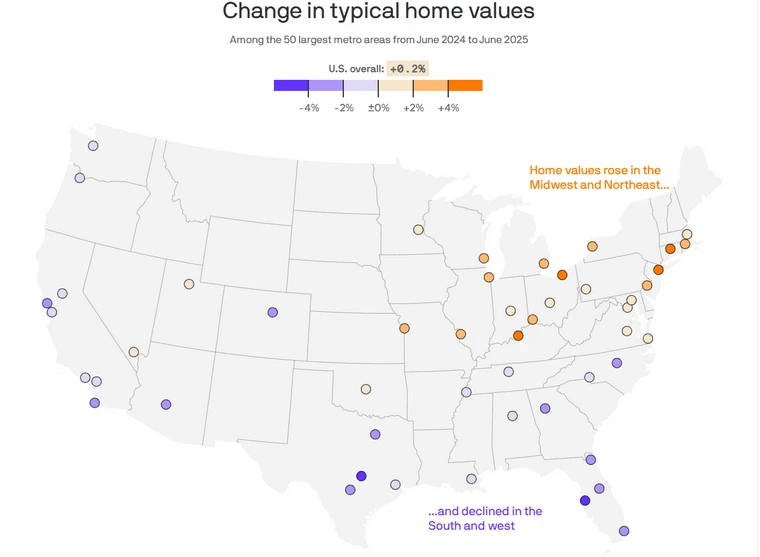
Source: Axios (August 2025)
The Economist reports that America’s housing market is losing steam, with most cities seeing price declines in the past three months as sales slow. The pain is sharpest in the South and West—cities like Dallas and Phoenix face 7% mortgages and falling values—while the Northeast and Midwest remain relatively resilient.
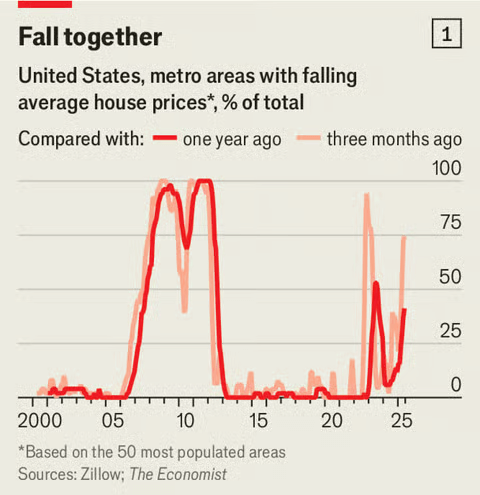
Source: The Economist (August 2025)
Pandemic boomtowns such as Austin and Miami are struggling with oversupply from covid-era construction, slower migration, and fading business allure, while some vacation hotspots in the Northeast are also cooling. Suburban markets near big cities, however, are holding up better as hybrid work makes slightly longer commutes feasible.
Jonathan Delozier of HousingWire reports that the price premium for new homes fell to a record low of 7.8% in Q2 2025, as the median new-home list price held steady at $450,797 while existing-home prices rose 2.4% to $418,300, making new construction a more competitive option for buyers.
Alex Harring of CNBC reports that Goldman Sachs expects housing to remain the weakest part of the U.S. economy in late 2025, with residential investment projected to drop 8% year-over-year in the second half. Chief economist Jan Hatzius cites declining affordability, a slowdown in immigration under Trump’s border crackdown, and a depressed multifamily sector as key drags, alongside contracting single-family starts. Rising use of mortgage buydowns highlights the strain on buyers, and a cooling labor market, evidenced by weaker-than-expected July jobs data, could deepen the sector’s slump.
The Federal Reserve
Christopher Rugaber and Josh Boak of AP News report that President Donald Trump will nominate Stephen Miran, current chair of the White House’s Council of Economic Advisers, to temporarily fill a Federal Reserve Board vacancy left by departing governor Adriana Kugler. If confirmed by the Senate, Miran will serve until January 31, 2026, marking Trump’s first chance to shape the Fed, which he has criticized for keeping rates unchanged. A staunch defender of Trump’s tax cuts and tariffs, Miran argues they will spur growth and reduce deficits while downplaying inflation risks, a stance likely to intensify concerns over political influence on the traditionally independent central bank.
CNBC quotes Marco Casiraghi, senior economist and strategist at Evercore ISI, as saying:
“By selecting Miran, Trump has made a stop-gap appointment and given himself until January to make the main call…This way Trump did not tie his hands, keeping his options open regarding the choice of the new Fed governor and especially the new Fed chair.”
Devika Madhusudhanan Nair and Ann Saphir of Reuters report that Federal Reserve Governor Christopher Waller has emerged as a leading contender for Fed chair under President Donald Trump. Waller, who met with Trump’s team but not the president, supports interest rate cuts to bolster a slowing labor market and argues tariffs won’t drive inflation, positions aligned with Trump’s push for lower rates, though he rejects linking rate policy to reducing government borrowing costs. A PhD economist and advocate for Fed independence, Waller dissented at July’s meeting in favor of cuts alongside Vice Chair Michelle Bowman.
The New York Post reports that President Trump’s team has expanded its shortlist for the next Federal Reserve chair to about 10 candidates, adding former St. Louis Fed President James Bullard and ex-George W. Bush economic adviser Marc Sumerlin to a field that still includes Kevin Hassett, Kevin Warsh, and, as noted above, the current Fed Governor Christopher Waller. The move comes as Trump continues criticizing Jerome Powell for not cutting rates and after appointing Stephen Miran to fill Adriana Kugler’s vacant Fed Board seat through January 2026.