

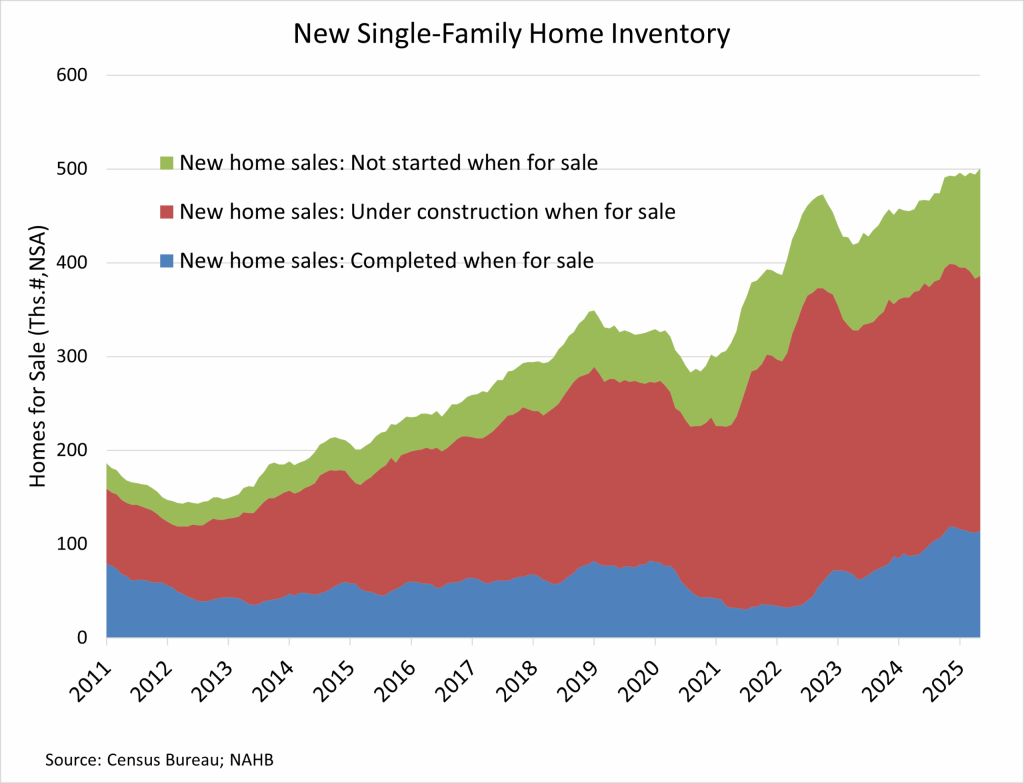
Logan Mohtashami of HousingWire reports that new home sales have underperformed expectations, with downward revisions to previous data and rising inventory levels, signaling a continued recession in residential construction. Despite the slowdown, builders are holding onto labor, anticipating lower interest rates in the future. Mohtashami emphasizes a key threshold: when completed new homes for sale near 120,000 units (as they now are), builders tend to pull back on new starts, explaining the current contraction without a crash in overall sales.
Danushka Nanayakkara-Skillington of the National Association of Home Builders (NAHB) highlights that new single-family home sales in June 2025 rose by just 0.6%, 6.6% below last year’s level, marking the slowest two-month stretch since October 2024. Inventory climbed to 511,000 homes, up 8.5% year-over-year, with a 9.8-month supply far above the balanced 6-month benchmark. Notably, ready-to-occupy dwellings rose 21.3% year-over-year to 114,000 but still represent just 22% of total inventory. Affordability remains strained, with only 14% of homes priced under $300,000, while 28% exceed $500,000.
Source: NAHB (July 2025)
Orphe Divounguy of Zillow reports that the median new home price fell to $401,800, down 2.9% year-over-year and the lowest since early 2021. While 37% of builders cut prices in June (up from 29% the previous year), the average discount remained at 5%, which is below last year’s 6%. With affordability still a concern, stagnant demand relative to rising supply is forcing builders to continue offering incentives.
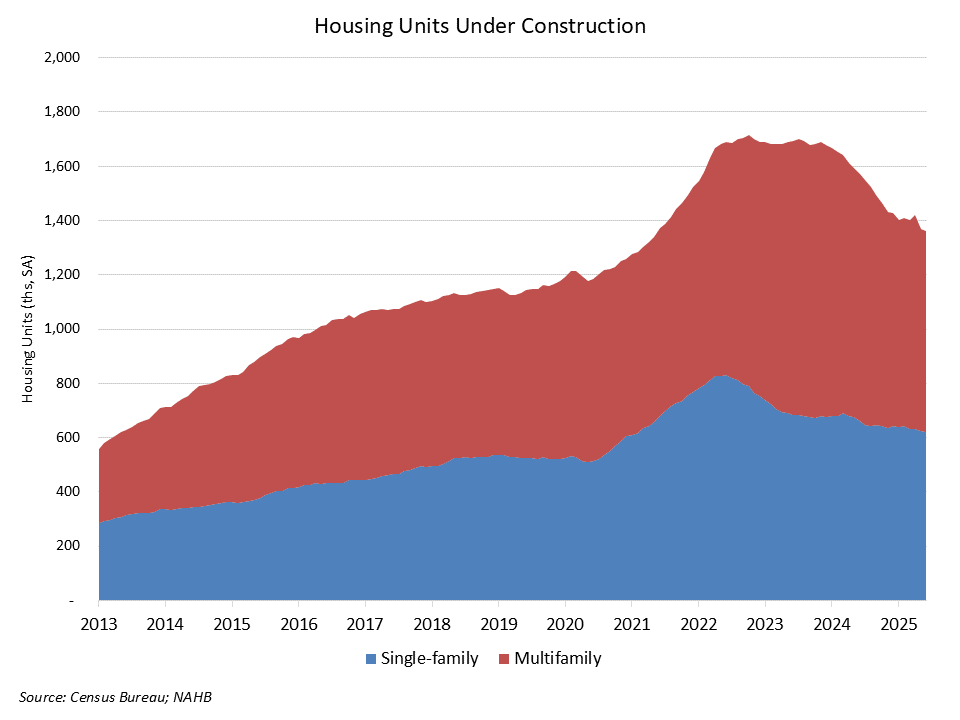
Robert Dietz of NAHB reports that single-family housing starts fell 4.6% in June to an annual rate of 883,000, the lowest since July 2024 and 10% below last year, amid high interest rates, rising inventories, and affordability challenges. While total housing starts rose 4.6% due to a 30% jump in multifamily construction, builder activity in the single-family segment continues to soften. Permits for single-family homes also dropped 3.7%, and the number of single-family homes under construction is now 6% lower year-over-year at 622,000, signaling a broader slowdown despite resilience in multifamily starts.
Source: NAHB (July 2025)
Joel Berner of Realtor.com reports that the Northeast saw the steepest drop in new home sales, plunging 27.6% month-over-month and 34.4% year-over-year, despite being the most supply-constrained market. The West also declined (-8.4% MoM, -14.4% YoY), while the South remained relatively stable (+5.1%, -4.4%). The Midwest stood out with a 6.3% monthly gain and 9% annual increase, an encouraging sign given its affordability and limited supply. Despite rising inventory (511,000 homes for sale, up 8.5% YoY) and falling prices, many buyers remain sidelined amid high mortgage rates and weakened confidence.
“For the first time in the past year, there are more new homes for sale (121,000) that have not yet been started than new homes that are completed and for sale (199,000). Builders are showing reluctance as well, preferring to get a commitment from a buyer first to start their projects rather than forging ahead and potentially being left with completed inventory they might struggle to sell.”
Rate decision
The Federal Reserve chose to hold rates steady at its latest meeting.
Ahead of the meeting, Jessica Dickler of CNBC reported that, despite mounting pressure from President Trump, who has called for rate cuts of up to 3 percentage points, the Fed was expected to hold rates steady at 4.25%-4.5%. Regionally, high mortgage rates, currently near 6.8%, continue to hinder housing affordability nationwide, particularly in supply-constrained areas such as the Northeast and West. While the Midwest remains more resilient, national borrowing costs remain elevated across credit cards (20%+ APR), auto loans (7.22%), and student loans (6.39%).
Rafael Nam of NPR recounts a rare and tense moment as President Trump visited the Fed’s D.C. headquarters and publicly clashed with Powell over the ballooning cost of the central bank’s renovation, now estimated by Trump at $3.1 billion, up from $1.9 billion. Powell disputed the figure, clarifying that part of the cited cost was from a separate, completed project. The encounter, held amid exposed beams and plywood walls, underscores Trump’s mounting frustration with Powell over stalled rate cuts. While Trump called for lower rates, he avoided direct attacks, saying, “I’d love him to lower interest rates, but other than that, what can I tell you?”
Ann Saphir of Reuters reported on the same meeting, noting that Trump told reporters he does not plan to fire the Fed chief, though he has threatened to do so in the past. The visit underscores growing political pressure ahead of today’s Fed decision, where policymakers were widely expected to hold rates steady despite the president’s push for aggressive easing.
Myles McCormick of the Financial Times reports that the White House intensified pressure on Powell ahead of the FOMC meeting, demanding “dramatically lower” interest rates despite expectations that the Fed would hold rates steady. Trump’s team, including budget chief Russell Vought and Commerce Secretary Howard Lutnick, slammed Powell for being “too late” and criticized the Fed’s $2.5 billion headquarters renovation as excessive.
Rents
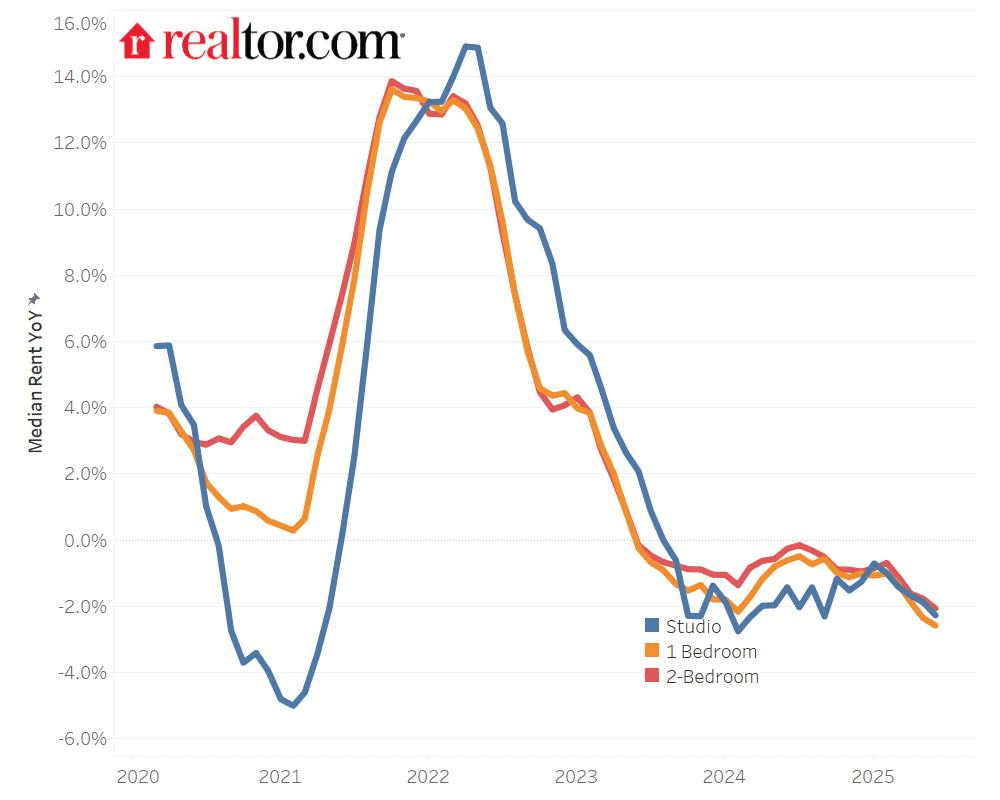
Jiayi Xu and Danielle Hale of Realtor.com report that in June 2025, renting a starter home remained significantly cheaper than buying in 49 out of 50 major U.S. metropolitan areas, with an average monthly savings of $908.
Source: Realtor.com
Despite a seasonal uptick, the national median rent ($1,711) marked its 23rd consecutive year-over-year decline, down 2.1% for units with 0–2 bedrooms. Studio, 1-bed, and 2-bed rents all fell, and rent growth year-to-date is just 1.2%, half the pace of last year. Austin led in rent-vs-buy savings, while Birmingham saw the most significant year-over-year increase in rental advantage. Only Pittsburgh favored buying over renting, as affordability continues to shift in favor of renters.
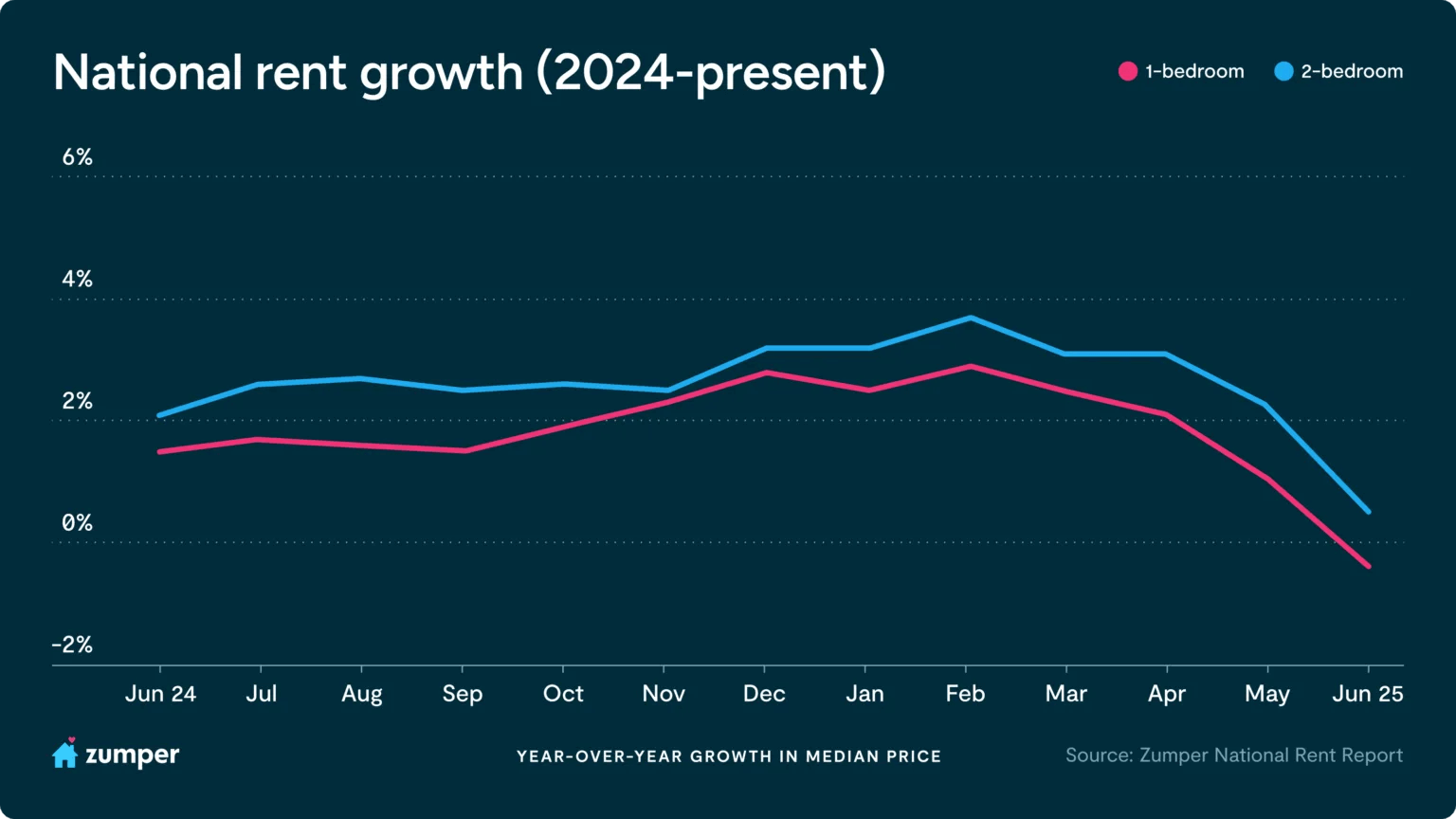
As of mid-2025, the rental market is showing unexpected signs of stabilization, with Zumper reporting flat national rent growth during what’s typically the busiest leasing season. June’s median rent for one-bedrooms held at $1,520, while two-bedrooms edged up just 0.2% to $1,910. Year-over-year, one-bed rents declined 0.4%, the first drop in over a year.
Source: Zumper (July 2025)
Urban hubs like New York and San Francisco continue to experience rising rents, driven by limited supply and policy changes, such as NYC’s FARE Act. Meanwhile, oversupplied Sun Belt cities like Austin and Phoenix continue to see annual declines, though those drops are slowing.
Anthemos Georgiades, CEO of Zumper, comments: “The current plateau seen in our national rent prices likely reflects a more deliberate and strategic approach by property owners…This isn’t a sign of weak demand, renters are still out there, but with so much new inventory on the market, landlords are prioritizing occupancy and staying competitive in an increasingly crowded landscape.”