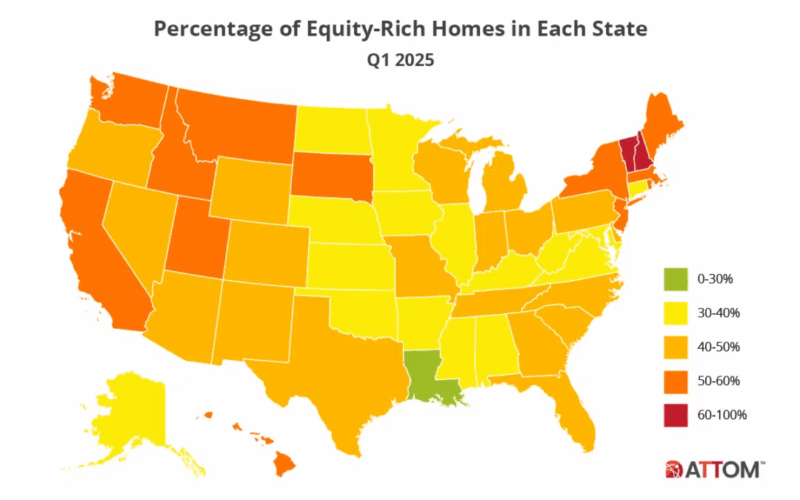
Hannah Jones of Realtor.com reports that Springfield, MA, topped its list of the hottest housing markets in June 2025 for the second consecutive month, driven by strong buyer demand and tight inventory. National home prices remained flat, but the hottest markets saw average annual price gains of 3.4%, with Rockford, IL, leading at 13.4%. Homes in these markets sold in just 30 days, over three weeks faster than the U.S. average, and received 2.9 times more listing views.
Source: Realtor.com (July 2025)
The Northeast and Midwest dominated the rankings, with New England metros being especially strong; 13 of the top 20 hottest markets were located in the Northeast, where housing inventory grew by only 16.5% year-over-year, the lowest regional increase nationwide.
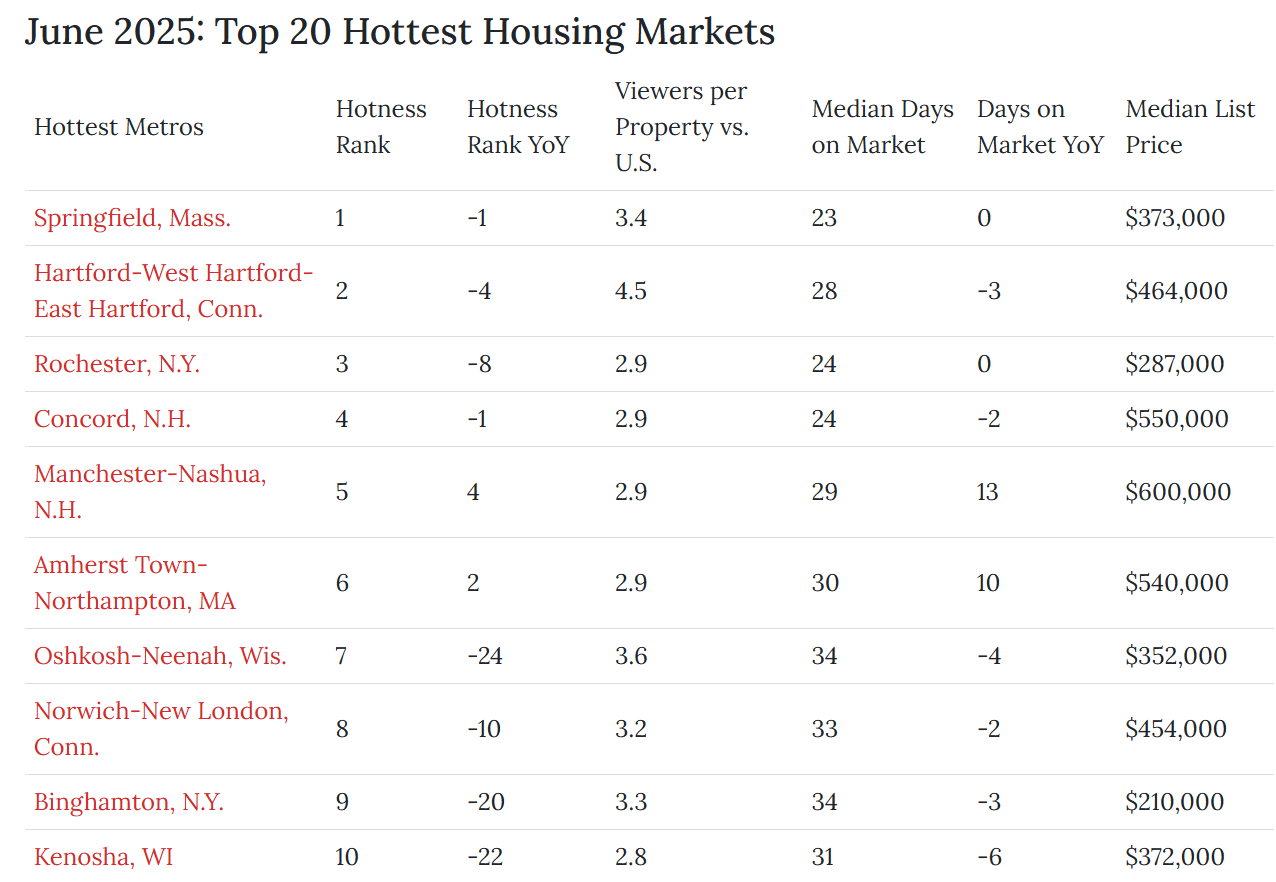
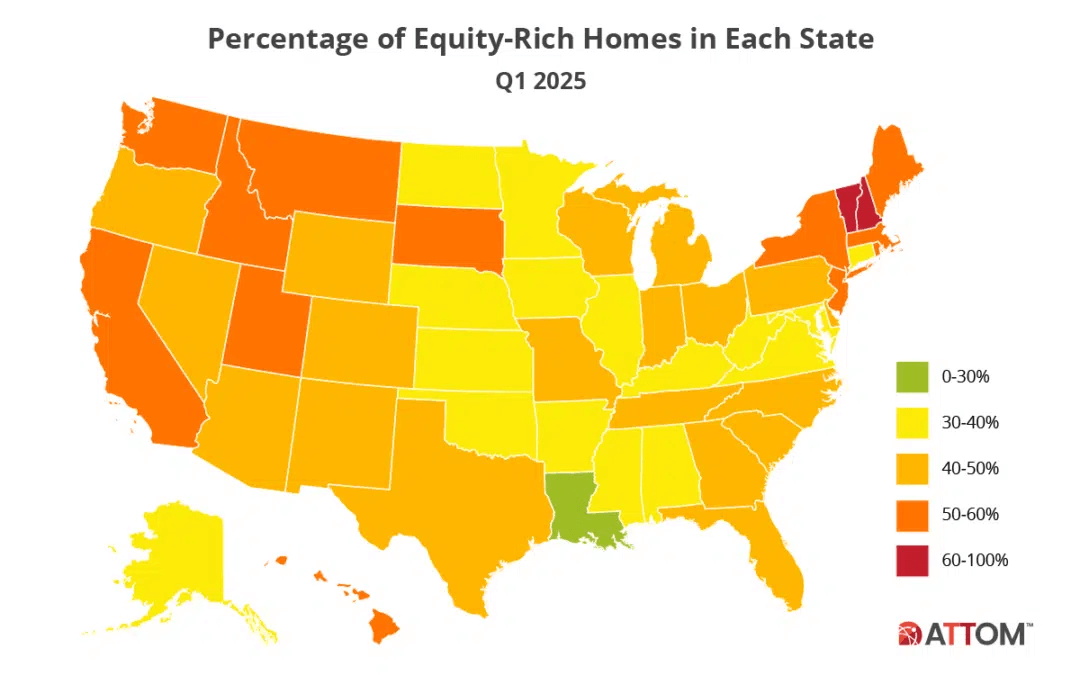
Jennifer Von Pohlmann of ATTOM Data Solutions reports that, despite a quarterly dip, U.S. homeowners remain historically equity-rich in early 2025, with 46.2% of mortgaged properties classified as equity-rich (where the loan balance is less than half the property’s market value), down slightly from 47.7% in Q4 2024.
Source: ATTOM (July 2025)
On a year-over-year basis, most states saw increases, with Vermont leading the nation at 85.8%, up from 82% in Q1 2024. New Hampshire followed at 60.5%, and Rhode Island at 59.8%, marking one of the most significant annual jumps. These states demonstrate continued financial strength among homeowners, particularly in counties such as Chittenden (VT), Carroll (NH), and Washington (RI).
Jennifer Von Pohlmann of ATTOM Data Solutions also reports on a second report revealing that home flipping remains widespread. However, profitability and activity levels vary significantly by state. Alabama stood out with a 9.9% flipping rate, well above the national average, and a robust 54.2% ROI on 978 flips, driven by low costs and quick resales. Arkansas also performed strongly with a 43.1% ROI on 466 flips, fueled by consistent returns on lower-priced homes. Arizona, despite being active with 2,657 flips, saw its profit margins narrow to a 15.7% ROI due to high costs and intense competition. California led in volume with 5,753 flips and a $124,000 median profit, though its 19.8% ROI lagged due to high acquisition costs and greater reliance on financing.
No July cut
Brad Finkelstein of National Mortgage News reports that despite earlier speculation, nearly all economists now expect the Federal Reserve to hold rates steady in July, with a potential cut more likely in September or later, following the June FOMC meeting. Indeed, the CME Fed Watch now shows a 97% chance of a rate hold at the July 30th meeting, with only a 3% chance of a 25-basis-point rate cut.
That said, Nicole Goodkind of Barron’s reports that Fed Governor Christopher Waller reaffirmed his support for a July rate cut, stating the decision should be based on data, not politics, even in light of June’s strong jobs report.
Howard Schneider of Reuters reports that Federal Reserve minutes from the June 17–18 meeting show little support for a July rate cut, with only “a couple” of the 19 policymakers backing an immediate move and most preferring to wait due to inflation concerns, especially tied to Trump’s proposed tariffs. While a majority still anticipate cuts later in 2025, likely starting in September, the overall tone emphasized caution, with no urgency to lower the current 4.25%–4.50% rate.
Colby Smith of the New York Times reports that while the Federal Reserve unanimously held rates steady in June, the meeting minutes reveal growing divisions among officials about the path forward, particularly amid economic uncertainty tied to President Trump’s tariff policies. The split reflects broader concerns about stagflation, with projections showing slower growth, higher inflation, and rising unemployment, forcing the Fed to balance competing pressures as it eyes potential rate adjustments.
Jennifer Sor of Business Insider reports that hopes for a July Fed rate cut were dashed after a strong June jobs report showed the economy added 147,000 jobs, well above expectations, while unemployment fell to 4.1%. The surprising labor strength sent the odds of a July cut plummeting from 23.8% to just 6.7%, pushing market expectations toward a potential September move instead. Bond yields surged on the news, with the 2-year Treasury jumping nine basis points, as the Fed appears poised to hold rates higher for longer.
Pending sales
Mark Worley of Redfin reports that pending home sales dropped 3.5% year-over-year in early July, one of the steepest declines since February, while the median U.S. home price hit a new record of $399,633, up 1%. Despite slower sales, signs of buyer interest are growing: mortgage applications rose 9% as rates fell to 6.67%, touring activity is up 25% since January, and home search interest on Google is at its highest level in a year.
Lillian Dickerson of Inman reports that despite affordability challenges, seller optimism is rising as mortgage applications jumped 9% with rates falling to 6.67%, the lowest since April. Touring activity is up 25% year-to-date, and Google searches for “homes for sale” are at a 12-month high, signaling renewed buyer interest amid a still-pricey but gradually shifting market.
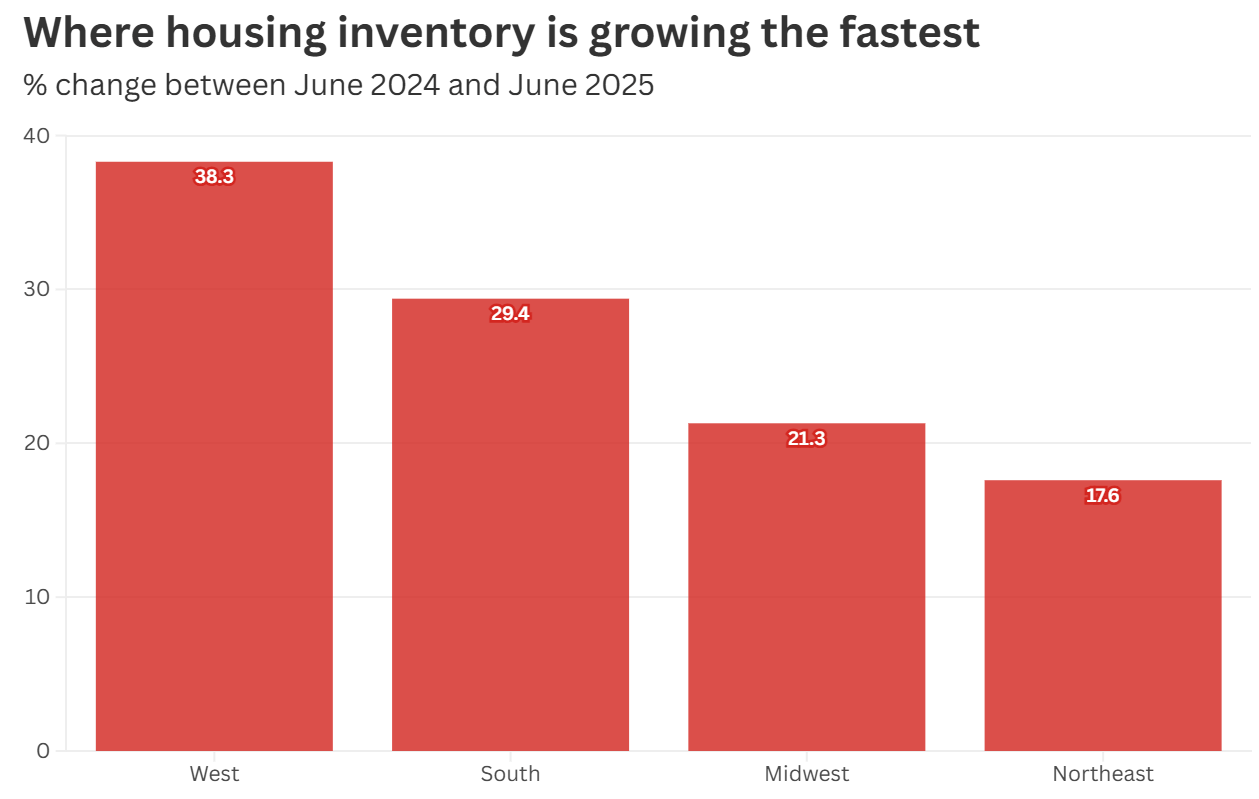
Giulia Carbonaro of Newsweek reports that unsold homes surged 20% year-over-year in June as the U.S. housing market stalls under the weight of high prices, elevated mortgage rates, and economic uncertainty. Inventory jumped nearly 29%, while pending sales dropped 1.6% and 3.5% in early July. Despite sluggish demand, home prices defied gravity, with the median list price reaching $440,950 and the median sale price hitting a record $399,633. Over 20% of listings saw price cuts, the highest for any June since 2016, highlighting a market caught between swelling supply and stubbornly high prices.
Source: Newsweek (July 2025)
“Growing inventory—especially in Sunbelt markets—is also offering buyers more options and giving them more negotiating power, offering them what are likely the best purchasing conditions in years. But sellers are starting to clock on the way the market has changed since the pandemic. In May, according to Realtor.com, delistings—the process of pulling for-sale homes out of the market—outpaced overall inventory gains, jumping 35 percent year-to-date and 47 percent year-over-year. In the same month, active listings were up 28.4 percent year-to-date and 31.5 percent year-over-year.”