Rental Property Cash Flow Calculator
Purchase
Financing
Income
Operating Expenses (Annual)
Return Targets
Cash Flow
Annual Gross Rent: $–
Vacancy Deduction: $–
Net Rent: $–
Property Tax Cost: $–
Insurance Cost: $–
Repairs & Maintenance Cost: $–
Property Management Cost: $–
Leasing Fees Cost: $–
Misc Expenses: $–
Total Expenses: $–
Net Operating Income (NOI): $–
Mortgage Payment (Principal + Interest): $–
Net Cash Flow (Annual): $–
Monthly Cash Flow: –
Positive numbers = surplus; negative = shortfall.
Cash-on-Cash Return: –%
Targets Achieved?
Target Monthly Cash Flow: –
Target Cash-on-Cash Return: –
Want to track cash flow on properties you already own? Check out Stessa.
Get 24/7 visibility into your portfolio’s financial performance with reports that are automatically generated and updated in real time. Create cash flow reports, income statements, balance sheets, collect rent, screen tenants and more, in just a couple clicks. Plus it’s free to get started.
Over 350,000 landlords use Stessa to get access to features like:
-
- Automated accounting tools
- Manual expense tracking
- One-click smart receipt scanning
- Mileage tracking
- Automated bank feeds
- Centralized dashboard with key metrics and complete chart history
- Rental applications
- Online rent collection and reminders
- Tenant screening
- Maintenance requests and tracking
- Landlord banking
- eSigning for documents and leases
- Mobile app (iOS and Android)
Go here to get started for free.
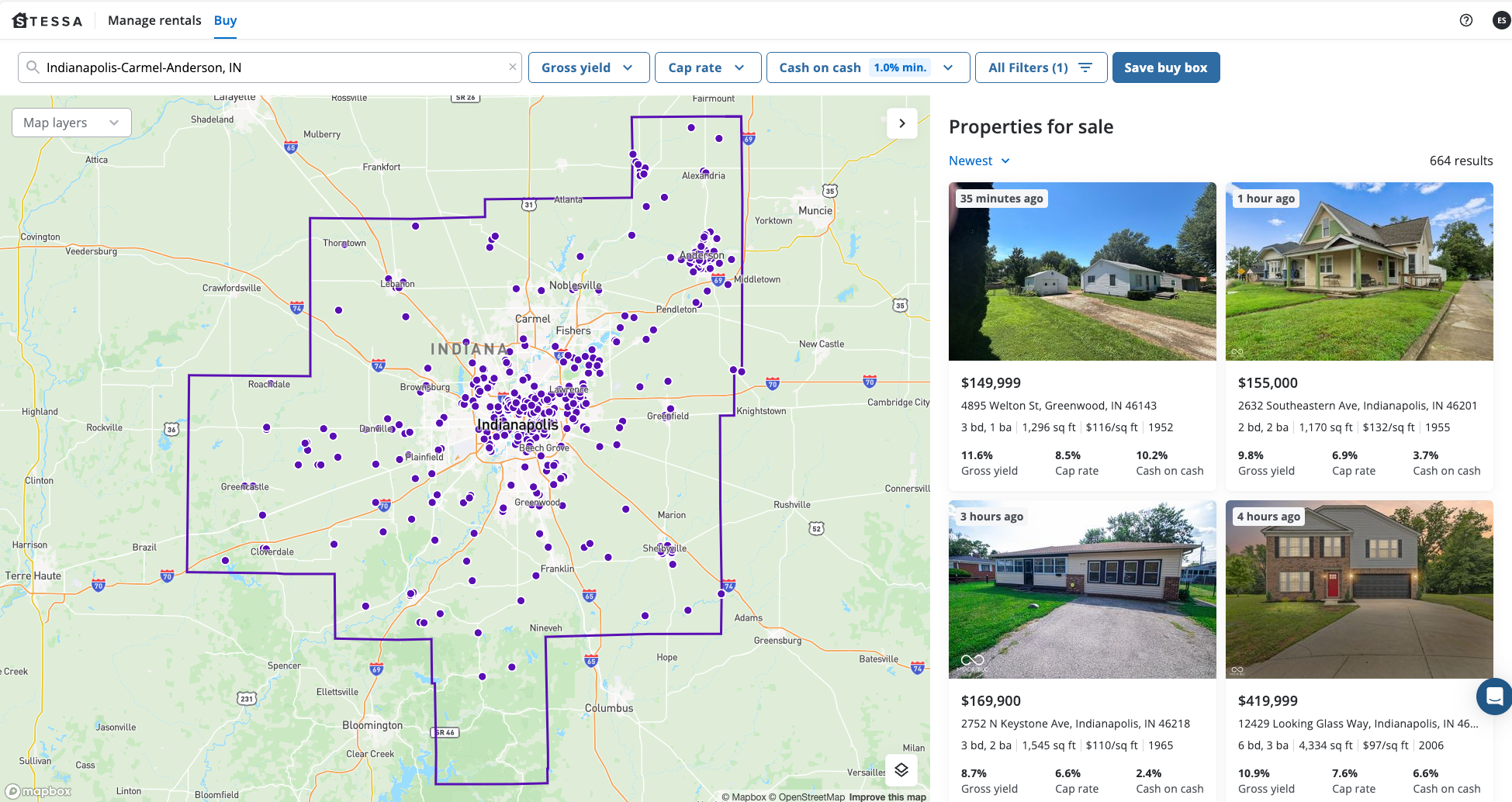
You can also buy and sell properties using Stessa’s investment property marketplace.
Unlike the generic listing sites built for browsing, Stessa is purpose-built for investors looking to underwrite and acquire their next investment. Evaluate properties with institutional-grade insights powered by Roofstock, and get notified in real-time when something meets your buy box.
How This Cash Flow Calculator Works
Purchase
-
Purchase Price ($) — used for loan sizing and (if in % mode) Property Tax.
-
Closing Costs (% or $) — one-time acquisition costs. Choose % of purchase or fixed $.
-
Cash invested for CoC = Down Payment + Closing Costs.
-
Financing
-
Down Payment (%) — determines loan amount: Loan = Purchase × (1 − DP%).
-
Interest Rate (%) & Amortization (years) — used to compute a standard fixed-rate, fully amortizing payment.
-
Mortgage Payment (P+I, annual) = 12 × monthly payment.
-
Income
-
Monthly Rent ($) — expected stabilized rent.
-
Annual Vacancy (days) — vacancy deduction based on days.
-
Annual Gross Rent = Rent × 12
-
Vacancy Deduction = (Gross ÷ 365) × Vacancy Days
-
Net Rent = Gross − Vacancy Deduction
-
Operating Expenses (Annual)
-
Property Tax (% or $) — toggle between % of Purchase or fixed $. (Default % = 1.5%; the $ field can mirror that.)
-
Insurance ($) — annual premium.
-
Repairs & Maintenance (% or $) — toggle between % of Gross Rent or fixed $.
-
Default % = 8%; the $ field auto-suggests 8% of annual rent if empty.
-
-
Leasing Fee (months) — Rent × months for tenant placement.
-
Property Mgmt Fee (%) — % of Gross Rent.
-
Misc Expenses ($) — HOA, landscaping, pest, utilities you cover, etc.
-
Total Expenses = sum of all annual expense items above.
Cash Flow & Returns
-
NOI (Net Operating Income) = Net Rent − Total Expenses
-
Annual Debt Service (P+I) — from Financing inputs.
-
Net Cash Flow (Annual) = NOI − Annual Debt Service
-
Monthly Cash Flow = Net Cash Flow ÷ 12
-
Cash-on-Cash Return = (Net Cash Flow ÷ (Down Payment + Closing Costs)) × 100
Targets Achieved? ✅ / ⚠️
Enter goals and the calculator flags Yes/No:
-
Target Monthly Cash Flow ($) → compared to Monthly Cash Flow
-
Target Cash-on-Cash Return (%) → compared to Cash-on-Cash
Why this is different: Beyond showing results, it evaluates whether the deal meets your targets and gives practical %/$ toggles for taxes, repairs, and closing costs so the math fits how you actually budget.
Understanding Each Input
Purchase
-
Purchase Price ($)
Contract price used for loan sizing and (if using %) property tax. -
Closing Costs (% or $)
One-time acquisition costs (lender fees, title, escrow, recording, etc.). You can enter a % of purchase or a fixed $; these are added to cash invested for Cash-on-Cash. Default is 2%. -
Down Payment (%)
Portion of the purchase paid in cash. Higher down payments lower debt service (often improving cash flow) but can reduce Cash-on-Cash. -
Interest Rate (%), Amortization (years)
Drive your monthly mortgage payment and total annual debt service.
Income
-
Monthly Rent ($)
Expected stabilized monthly rent. -
Annual Vacancy (days)
Estimated days per year the unit sits vacant.
Operating Expenses (Annual)
-
Property Tax (% or $)
Choose % of purchase or fixed $. The default % is 1.5%; the $ field can mirror that amount. -
Insurance ($)
Annual landlord policy premium. -
Repairs & Maintenance (% or $)
Choose a % of gross rent or fixed $. Default % is 8%; the $ field suggests 8% of annual rent if empty. -
Leasing Fee (months)
Cost to place a tenant, as months of rent (e.g., 0.5 = half a month). -
Property Mgmt Fee (%)
% of gross rent paid to a manager. Include it even if you self-manage to avoid overly rosy projections. -
Misc Expenses ($)
Catch-all for other fixed annual costs (HOA, pest, landscaping, utilities you cover, etc.).
Return Targets
-
Target Monthly Cash Flow ($) — default $100
-
Target Cash-on-Cash Return (%) — default 6%
Frequently Asked Questions
What makes this calculator different?
Two things:
-
You can set targets for Monthly Cash Flow and Cash-on-Cash, and we’ll mark Yes/No with a green check or red alert.
-
You get practical % / $ toggles for Property Tax, Repairs & Maintenance, and Closing Costs, so the model matches how you actually underwrite.
Why include Closing Costs in Cash-on-Cash?
They’re real dollars out of pocket at purchase. Including them in the Cash-on-Cash denominator (Down Payment + Closing Costs) gives a more honest yield.
How are vacancy and leasing fees modeled?
Vacancy is days per year. Leasing fees are months of rent and applied annually—an easy way to approximate average turnover over time.
Do you calculate taxes, DSCR, or cap rate?
No. This tool is deliberately cash-flow focused (pre-tax, with debt service). For tax-aware underwriting or other ratios, use our income tax calculator or rental property ROI calculator.
How is the mortgage payment calculated?
As a standard fixed-rate, fully amortizing loan using your rate, term, and loan amount (based on purchase price less the down payment).
Tips for Better Underwriting
-
Stress-test: try rent (±5–10%), vacancy (+10–20 days), and rate (±1%) to see if you still meet your targets.
-
Use the toggles: switch Property Tax and Repairs between % and $ to mirror your market or a known bill.
-
Budget closing costs realistically: small misses here can swing Cash-on-Cash more than you expect.